Civic Participation & Urban Development in Göttingen
Civic Participation & Urban Development in Göttingen: How You Can Help Shape Future Decisions
Urban development determines how Göttingen will feel in the coming years: from the use of the city center to mobility and the quality of stay in neighborhoods. This article explains the participation pathways that will be open to you in the future – from formal rights under municipal law to dialogue-oriented formats such as citizens' assemblies/future forums and digital participation opportunities.
Binding Participation Rights: Your Formal Path
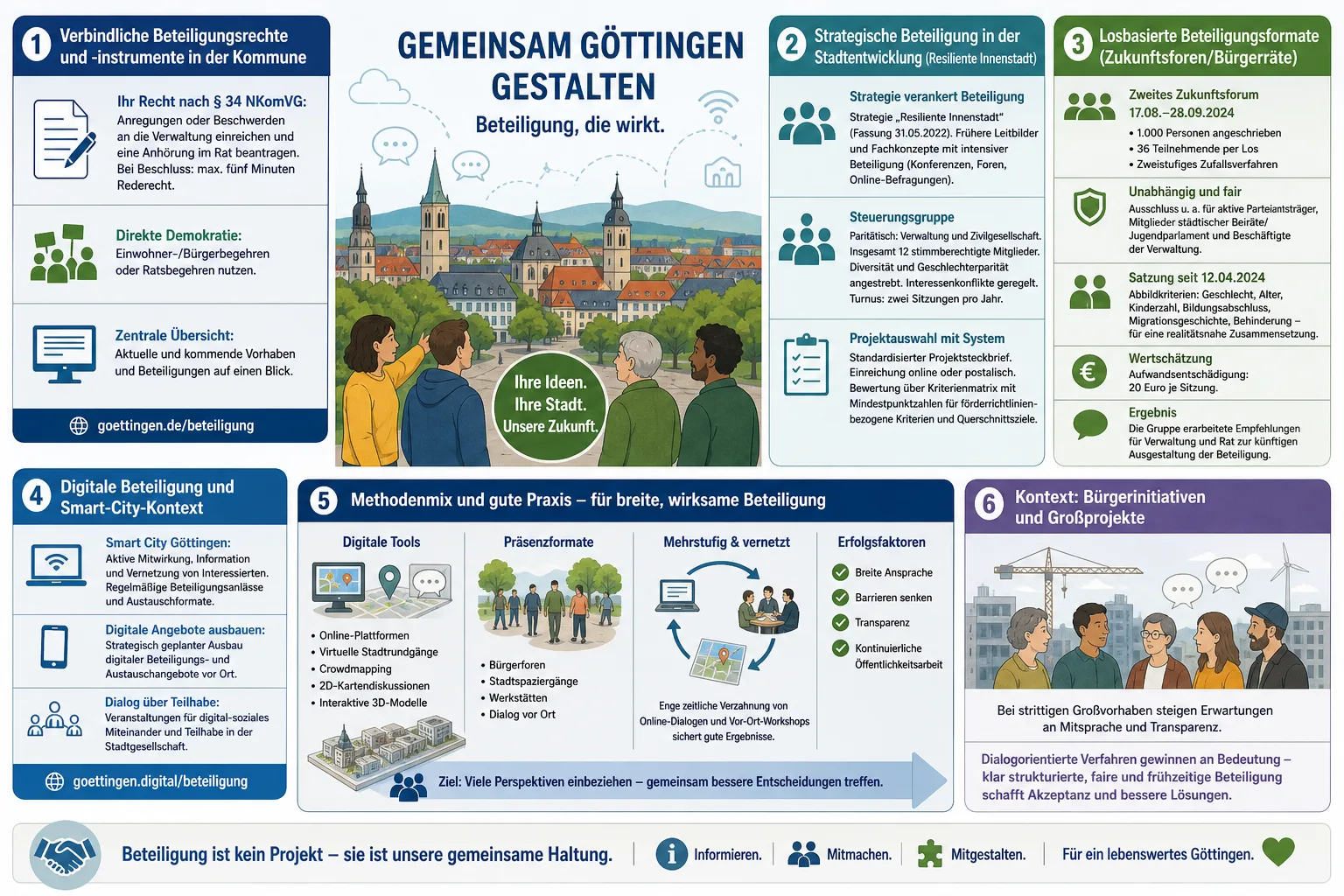
Regardless of individual projects, there is a permanent, legally regulated minimum instrument: the right of residents to submit applications or the right to make suggestions and complaints to the municipality. In Lower Saxony, this arises from the Lower Saxony Municipal Constitution (NKomVG), § 34. This right is particularly relevant if you have a concern that should be addressed promptly by the administration or politics.
This Is How You Can Practically Use the Participation Right in the Future
- Specify your concern: Describe the problem, the location/affected group, and a concrete proposal (e.g., "safer crossing," "better signage," "more seating").
- Justification and impact: Briefly explain what effects you expect (safety, accessibility, quality of stay, inclusion).
- Attach evidence: Photos, sketches, counts (e.g., during peak times), or references to relevant regulations/guidelines increase verifiability.
- Request feedback: Ask for confirmation of receipt and a brief update on how your concern will be processed internally.
Additionally, depending on the topic and formal requirements, other direct democratic instruments (e.g., petitions/referenda) may play a role in the future. These are subject to clear rules; details are set out in municipal and electoral law as well as municipal statutes.
City Center in Transition: Participation in Future Concepts and Projects
City centers continue to change: due to online retail, new work models, climate risks (heat, heavy rain), and mobility transformation. For Göttingen, this means that in the coming years, decisions will likely have to be made repeatedly regarding mixed use, public spaces, and accessibility.
Future city center processes will often be organized as integrated projects: multiple goals (economy, climate, social issues, design, mobility) are considered together. For citizens, this is a chance not only to discuss individual measures, but also priorities and goal conflicts – for example, between delivery traffic and quality of stay or between densification and green spaces.
How to Recognize Upcoming Projects
- Project profiles and criteria: Many programs use standardized descriptions (goals, cost framework, impact, risks) and sets of criteria.
- Multi-stage decisions: There is often an early ideas phase, then variants/designs, then resolutions. Participation is most effective in the early phase.
- Feedback: Good procedures publish results and justify decisions – so that contributions do not "disappear into the void."
Future Forums/Citizens' Assemblies: Randomly Selected Perspectives for Upcoming Decisions
In addition to open participation formats, lot-based citizens' assemblies (often called future forums) can also be used in Göttingen in the future. The principle: a group of residents is composed by random selection so that it represents the population as broadly as possible. This is intended to ensure that voices are represented that are less common in traditional evening events or political committees.
How Such Formats Typically Work in the Future
- Invitation & selection: Invitations are sent from an official register; participants are drawn from responses. Characteristics such as age, gender, and other factors are often considered for balance.
- Working phase: Participants receive understandable information, hear different perspectives, discuss in a moderated setting, and formulate recommendations.
- Handover & response: Recommendations are handed over to the administration and political committees; it is important that the city then publicly explains how it will proceed with them.
Even if recommendations are usually not automatically legally binding, they can noticeably influence future decisions – especially if the administration and politics transparently explain which recommendations are adopted, adapted, or rejected.
Digital Participation & Smart City: Have Your Say When Processes Take Place Online
Digital participation is likely to become more important in the coming years: it enables involvement regardless of working hours, mobility, or care responsibilities. In smart city contexts, it is not just about technology, but about how data and digital tools can support urban development – in a transparent, privacy-compliant, and citizen-oriented way.
Digital Formats Frequently Used in Future Procedures
- Online maps (crowdmapping): Report problem areas, favorite places, or suggestions directly on the city map.
- Online dialogues with comments: Drafts are published; citizens can ask questions, mark priorities, or suggest alternatives.
- Visualizations (2D/3D): Variants become more understandable, for example in square design or traffic routing.
- Hybrid events: On-site appointments are supplemented by livestream, documentation, and online feedback.
In online procedures, pay particular attention to two points: data protection information (what data is collected?) and procedure rules (until when can contributions be submitted, how are they evaluated?).
Method Mix: This Is How Future Participation Processes Typically Work
Many successful procedures combine formats because different people are reached in different ways: some prefer written/online, others direct conversation on site. A typical future process might look like this:
- Start & orientation: The city publishes the reason, goals, decision framework, and schedule – ideally with an understandable summary.
- Idea and needs collection: Online map, short survey and/or open consultation hours collect everyday feedback.
- On-site formats: City walks or site visits check feedback in reality (lines of sight, barriers, noise, heat islands).
- Workshops/planning dialogue: In moderated groups, options are compared and criteria (e.g., safety, climate, inclusion) are applied.
- Feedback ("What came of it?"): Results and decisions are published; contributions are transparently assigned (e.g., "adopted/partially/rejected – justification").
If you participate in the future, your leverage is greatest if you get involved early and make your feedback as concrete as possible: location, time, affected groups, and a solution idea.
How to Get Involved in the Next Participation Process
To make sure you don't miss the next opportunity, a simple routine for the coming months helps:
- Regularly check the city's participation and project pages: New procedures are usually announced and documented there.
- Use newsletters/notifications if offered: This way you will be notified as soon as new dialogues start.
- Collect your own observations: Short notes (when/where does a problem occur?) and photos support later contributions.
- Coordinate with others: If several people describe the same problem (e.g., school route, barrier), the need for action often becomes clearer.
- Insist on feedback: Serious procedures explain how contributions are taken into account. Ask if this remains unclear.