Discovering Industrial Culture & Architecture in Göttingen
Industrial Culture & Architecture in Göttingen: Ideas for Your Next Search for Traces
This overview is intended as a planning and discovery guide for future visits. Instead of looking back, the focus is on upcoming explorations, possible tours, and concrete observation tips.
A future walking tour: compact & flexible
For your next visit, you can plan a tour in three modules. This way, you remain flexible if opening times, weather, or accessibility change at short notice.
Module A: Old Town as a "building catalog" (approx. 60–90 minutes)
- Start in the city center and make it your goal to consciously compare at least three different building types (residential house, public building, functional building).
- Don't just stick to the main routes: Deliberately plan detours into side streets to discover backyards, passageways, and conversions.
Module B: Knowledge & City (approx. 45–75 minutes)
- Include a stop at a publicly accessible learning or collection site (e.g., library, foyer, exhibition area—if open).
- Use information boards, notices, or websites as a "context booster": This way, you connect buildings with use, conversion, and neighborhood development.
Module C: Technology & Infrastructure (approx. 60–120 minutes)
- Expand your route by at least one infrastructure topic (railway, water, energy, logistics, industrial areas).
- If you want to visit a production or technology site, plan prior research (access only with guided tour, safety rules, ID/registration).
Tip for your planning: Set two alternatives in advance (bad weather option and "outdoor only" option). This way, your visit will be coherent in any case.
What to look out for along the way: details that make "industrial culture" visible
Industrial culture often does not appear as a single "highlight" during future city explorations, but as a pattern of many small clues. With these observations, you make it tangible:
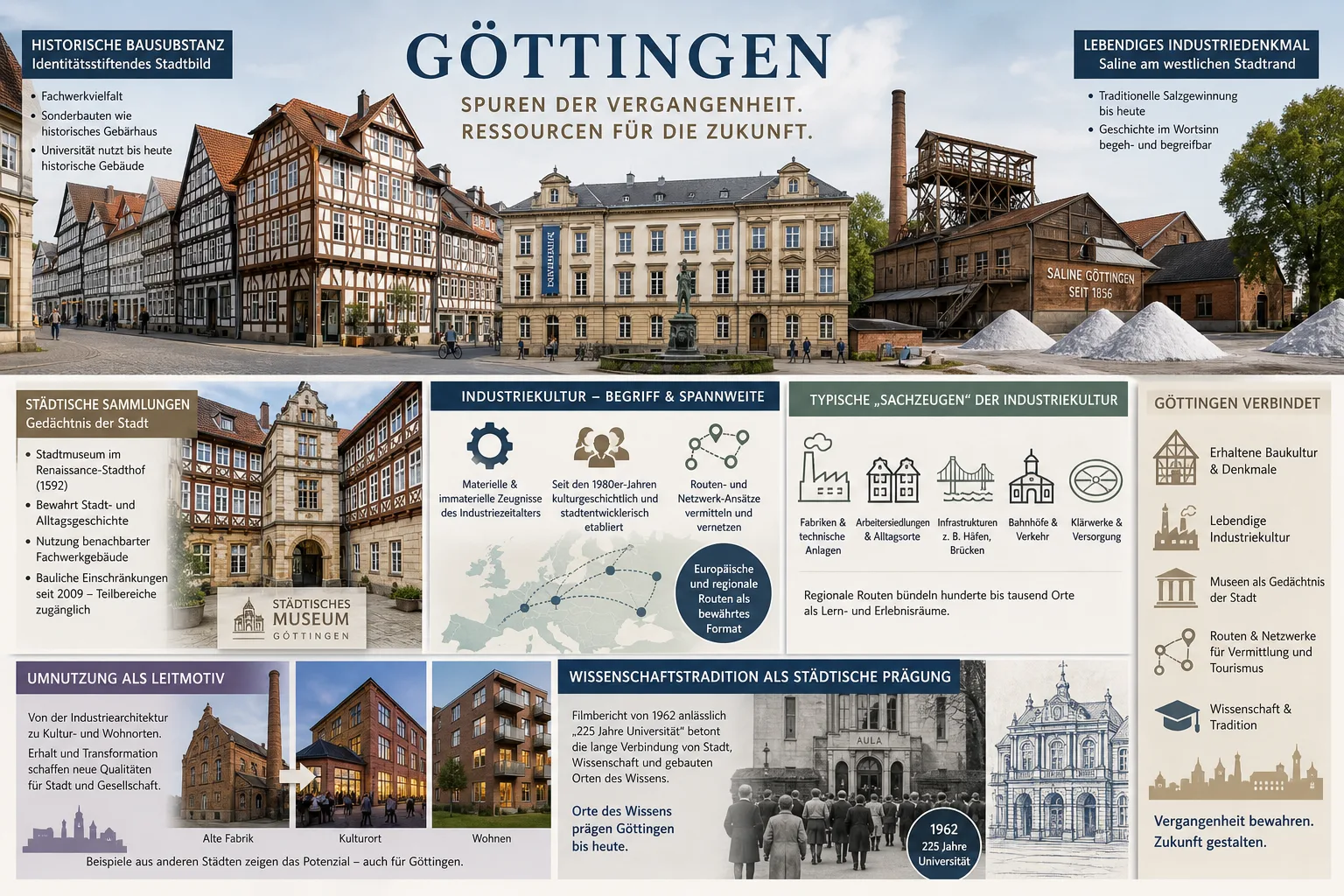
- Material changes: Half-timbered, natural stone, brick, concrete, or steel—different materials can indicate various construction phases, repairs, or changes in use.
- Traces of function: Large gates, loading ramps, vents, protective grilles, firewalls, or unusual floor heights often indicate commercial or functional use.
- Conversions & subsequent uses: Look for newly installed windows, additional staircases, ramps, or elevators—they show how buildings are being reused in the future (residential, offices, culture, education).
- Supply routes: Look at manhole covers, pipeline markings, watercourses, and bridges—supply networks are among the most important (often overlooked) layers of industrial culture.
- Signage & names: Street names, information boards, and historical company signs (if available) are quick entry points for later research.
Places of knowledge: how to meaningfully include university and learning locations
For future visits, it is worthwhile to consider "buildings of knowledge" as part of the city's narrative: They connect architecture, everyday life, and urban development. To keep your visit reliable, the method is more important than a specific place.
This is how you proceed practically
- Choose a publicly accessible anchor point (e.g., freely accessible exhibition area, library foyer, event room—depending on current operation).
- Check access rules in advance (opening times, bag rules, photo permission, accessibility).
- Use the place as a context station: Collect terms/dates from information material and research them further later.
This creates a future-proof route that also works if individual buildings are not accessible at the moment.
Technology and production sites: how to explore them for yourself
If you want to include technology or production sites in your next visit to Göttingen, reliability is especially important: Many locations are safety-relevant or only accessible as part of guided tours.
Checklist for the next visit
- Clarify access: Are there public tours, action days, or pre-registrations?
- Observe safety rules: Sturdy shoes, minimum age, protected areas, photo rules.
- Set expectations correctly: Some places can only be experienced from the outside—that can also be exciting if you pay attention to function, logistics, and integration into the neighborhood.
- Respect for operations & residents: No blockades, no drones without permission, quiet in residential areas.
If a production site offers tours, this can greatly enhance your route—because you understand processes (energy, water, raw materials, transport) as an interconnected system, instead of just seeing "beautiful buildings".
Museums & exhibitions: how to reliably plan your visit
Museums are particularly helpful for future explorations because they provide terms, timelines, and objects that you will later recognize in the urban space. So you don't rely on assumptions, plan through verifiable steps:
- Check current information (website/program/phone): opening times, ticket model, accessibility, closing days.
- Define guiding questions: "What functions did the building/neighborhood have?", "What infrastructure made that possible?", "What subsequent use is planned/typical?"
- Plan follow-up: 10 minutes of notes are enough to later compare your impressions with sources.
Note on reliability: Since programs, renovations, and access can change, checking museum and site information on the day is the safest way to avoid disappointment.
Traveling sustainably: respectful, accessible, sustainable
- Prioritize public transport & walking: Industrial culture routes work especially well as walks plus individual public transport hops.
- Consider accessible alternatives: Plan level route options in advance and check elevators/ramps at the places you want to visit inside.
- Respect monument protection: No "shortcuts" through private courtyards, no touching sensitive surfaces, no stickers/markings.
- Good photography etiquette: There are often rules indoors; in operational areas, safety and confidentiality aspects may play a role.
A good industrial culture tour is rarely the longest—but the one where you recognize functions, traces, and connections and later research them thoroughly.
Sources
- UNESCO World Heritage Convention – Convention Text — Framework for the importance of protection, mediation, and management of cultural heritage (accessed 2026-09-30)
- ICOMOS – Charters and other doctrinal texts — Foundational texts on monument protection, authenticity, and conservation principles (accessed 2026-09-30)
- German National Committee for Monument Protection — Overview of monument protection, mediation, and current perspectives (accessed 2026-09-30)
- European Commission – Culture — Cultural policy and programs in the European context, including cultural heritage (accessed 2026-09-30)