Film & Television made in Göttingen – from studio to image film
Film & Television made in Göttingen: What will be created in the coming months and years – from set to social video
A future-oriented overview for companies, cultural actors, up-and-coming creators, and everyone who wants to plan shoots, develop formats, or build media literacy in Göttingen.
What matters now: Moving images are becoming more local, faster, and more strategic
In the coming months and years, video production in Göttingen will mainly grow where content is published quickly, clearly measured, and consistently developed: on social platforms, in recruiting campaigns, in science communication, in cultural marketing, and in internal learning formats. At the same time, the demand for craftsmanship and credibility is increasing: good storytelling, clean sound quality, legally compliant use of music and images, more accessible subtitles, and transparent production processes.
This article bundles the most important developments and shows how upcoming projects in Göttingen can be efficiently planned – from the first briefing to distribution.
Which formats will be particularly in demand in Göttingen in the future
The next production waves typically arise where organizations need to communicate regularly and at the same time want to build trust. Particularly relevant are:
- Employer branding and recruiting videos (short, authentic, with a clear message about roles and location)
- Science and educational formats (explainer videos, lecture snippets, lab and project portraits)
- Event and congress content (aftermovies, recaps, interview formats, highlights for social and website)
- Social-first series (recurring segments, quick tips, behind-the-scenes, mini-documentaries)
- Image films with modular assets (one main film plus many short variants for different channels)
- More accessible videos (subtitles, good readability, clear audio guidance; additional versions if needed)
For teams, this means in the future: less "one film per year," more "continuous content engine" – with reusable setups, templates for graphics, and a reliable approval process.
How a professional production will typically proceed in the future (without friction losses)
1) Briefing & goal definition
Before camera and lighting are set up, success is decided: target audience, core message, desired action (call-to-action), channel strategy, and metrics should be determined in advance. In the coming years, this step will become more important because content is produced for multiple platforms in parallel.
2) Concept, shooting plan & rights clearance
A future-proof concept takes into account from the start: original sound statements, required B-roll, graphics, music license, consents, shooting permits, and data protection if people are recognizable. Social formats in particular benefit from clear series elements (intro, recurring segment, durations, hook).
3) Shooting (efficient, safe, strong sound)
In practice, sound quality is increasingly becoming a quality marker. Therefore, many teams will increasingly rely on clean miking, quiet recording conditions, and controllable lighting. At the same time, demands for speed are rising: compact setups, clear roles on set, and a shooting plan that enables multiple assets per location.
4) Post-production & versioning
In the coming years, there will be less focus on "one final cut" and more on versioning: multiple formats (9:16, 1:1, 16:9), different lengths, subtitle variants, and thumbnails. A structured review process with fixed feedback rules saves time and protects quality.
5) Distribution, evaluation & iteration
Distribution is part of production: upload standards, metadata, subtitle files, chapter titles, landing pages, and learnings from performance data flow into the next episode or campaign. This will make video production in Göttingen more measurable and plannable in the future.
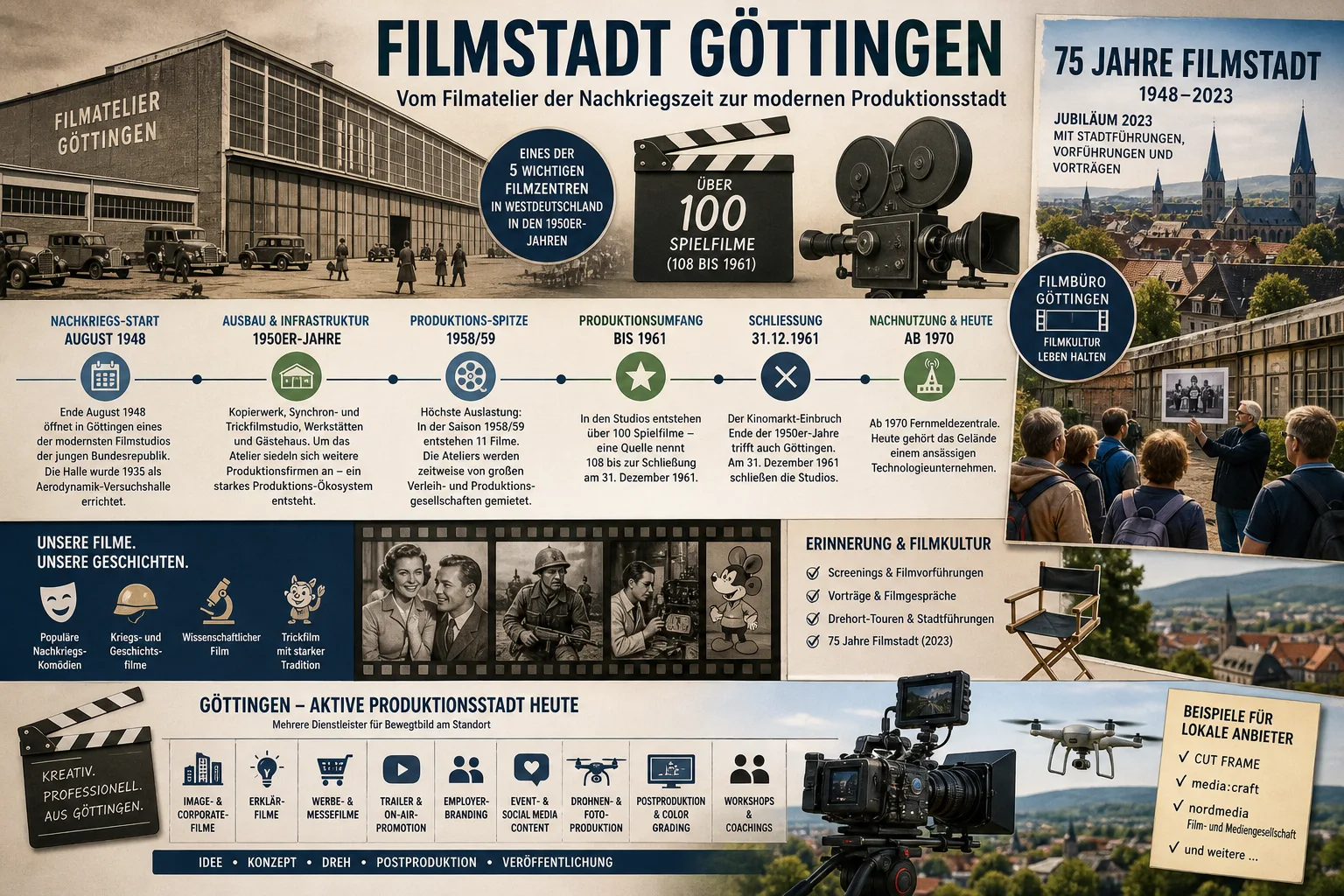
Why Göttingen will score as a shooting and production location in the future
- Versatile settings in a small area: City center, green surroundings, modern architecture, and science-related settings enable varied visual worlds without long distances.
- Knowledge and educational environment: Formats around research, innovation, teaching, and transfer will continue to gain importance in the coming years.
- Plannable logistics: Short distances make it easier to shoot at multiple locations in one day and reduce costs, complexity, and CO₂ expenditure.
- Authenticity: Local perspectives work particularly well in social formats and employer branding because they appear credible and clearly stand out from the generic stock look.
What can become visible next in culture, education, and city life
In Göttingen, formats that bring people together and strengthen media literacy will especially grow in the coming years. These include in particular:
- Film and media evenings with context (e.g., on visual language, disinformation, editing effects, and storytelling)
- Workshops on camera, sound, editing, mobile video, and content strategy
- City- and location-oriented offerings that show how settings work, how shoots are planned, and what rules apply in public spaces
- Cooperations between culture, education, and local productions, for example for project weeks, short film or documentary formats
Such offerings pay off twice: They promote creativity and at the same time a realistic understanding of how professional productions are created – including effort, roles, rights, and responsibility.
Quality & trust: Standards that will decide in the future
The more video is published, the more content will differ through reliability and care. Those who want to be visible and credible in Göttingen in the future should pay particular attention to:
- Traceable statements: Claims should be verifiable; use numbers and superlatives only if they can be checked.
- Rights & consents: Music, images, shooting locations, and recordings of people must be properly licensed or released.
- Transparency: If content is promotional, this should be clearly recognizable; for interviews: make context and roles understandable.
- More accessible implementation: Subtitles, clear language, good contrast in graphics, and understandable audio guidance are increasingly becoming standard.
- Data protection & security: Especially for internal training or HR content, access rights, storage duration, and approvals are central.
Practical checklist for upcoming shoots in Göttingen
- Define goal & channel: What should be different after the video (applications, registrations, understanding, trust)?
- Decide on format: Social clip, series, interview, explainer video, or modular image film?
- Create storyboard/outline: Hook, key points, evidence, conclusion with clear action.
- Check rights: Music license, usage rights, consents, logos/brands, shooting locations.
- Production plan: Roles, schedule, locations, backup option for weather, sound setup.
- Plan post-production: Subtitles, graphics, versions, feedback rounds, approval process.
- Prepare distribution: Title/thumbnail, description, subtitle files, tracking, landing page.
- Document learnings: What worked, what will be improved in the next production?
Further sources & standards
- urheberrecht.org — Classification on copyright, licenses, and usage rights in the German-speaking context (accessed 2026-06-10)
- GDPR.eu — Overview of the GDPR and practical questions about personal data (accessed 2026-06-10)
- W3C Web Accessibility Initiative (WAI) — Basics and recommendations for digital accessibility, including media/content (accessed 2026-06-10)
- Federal Agency for Civic Education (bpb.de) — Background knowledge on media literacy and media impact (accessed 2026-06-10)