
Klostergang, Braunschweig
Klostergang, 38104 Braunschweig, Germany
Riddagshausen Abbey | Monastery Church & History
Riddagshausen Abbey in Braunschweig is not a place to just check off quickly, but a historical ensemble that unusually combines monastic culture, church architecture, landscape, and quiet paths. Those who come to Riddagshausen today experience a former Cistercian complex, whose spiritual center is the monastery church of St. Mary, while the ponds, meadows, paths, the monastery garden, and the museum extend a visit far beyond a simple tour. The complex is located in one of the city's most well-known recreational areas and is simultaneously part of a centuries-old tradition of prayer, work, fish farming, and landscape care. This mixture makes Riddagshausen so special: Here, Gothic architecture, vibrant community culture, nature experiences, and Braunschweig's history come together directly. The monastery church is open daily, guided tours are regularly offered, and throughout the surroundings, one feels that this place is still not just a monument but a lived space. ([klosterkirche-riddagshausen.de](https://klosterkirche-riddagshausen.de/ueber-das-kloster/))
Monastery Church Riddagshausen: History, Architecture, and Reformation
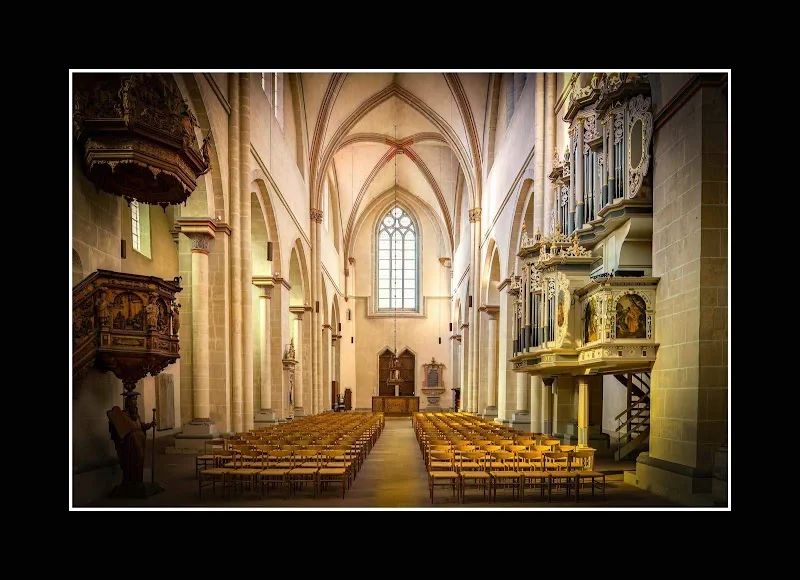
The historical depth of the monastery church begins in the 12th and 13th centuries. According to the city of Braunschweig, the monastery was founded in 1145; the current monastery church of St. Mary was constructed from 1216 to 1275 as an early Gothic three-nave pillar basilica with a transept, closed rectangular choir, choir ambulatory, and chapel ring. The church is among the oldest Gothic buildings in Germany, after the Magdeburg Cathedral. Typical for Cistercian churches is the roof rider instead of a massive tower. After the destructions during the sieges of 1550 and 1606 and with the introduction of the Reformation in 1568, the church became an Evangelical-Lutheran parish church; its current furnishings mainly date from the 17th and 18th centuries. Therefore, those who visit the interior encounter not a museum-like stagnation, but a church that has been continually used, changed, and preserved over many centuries. ([klosterkirche-riddagshausen.de](https://klosterkirche-riddagshausen.de/ueber-das-kloster/))
This tension between strict monastic architecture and later liturgical use is what makes Riddagshausen appealing. The medieval form of the church is still clearly discernible today: the early Gothic spatial effect, the interplay of nave, transept, and choir, as well as the simplicity typical of the order create an atmosphere that visitors immediately perceive. At the same time, the church is not frozen in time but part of an active community. It is used for services, baptisms, weddings, anniversaries, and concerts. The historical development is therefore not only a topic for specialists but shapes the daily perception of the place. Those searching for Riddagshausen Monastery or Riddagshausen Monastery Church often seek exactly this connection of architecture, faith, and developed continuity. In Braunschweig, Riddagshausen is one of the few places where city history can be impressively read from a specific, still accessible architecture. ([klosterkirche-riddagshausen.de](https://klosterkirche-riddagshausen.de/ueber-das-kloster/))
The surroundings of the church are also historically noteworthy. The ensemble was not randomly established at this location but strategically positioned on a descending ridge at the intersection of Wabetal and pond-fed depressions. This location was functionally and spiritually significant for the monks: protected, economically sensible, and closely related to the shaped landscape. In front of the gates, a village developed over the centuries, which later became the district of Riddagshausen. Even today, one can feel this connection of monastic order and village continuity when walking along the monastery path, past the historical buildings and the gatehouse to the church. Precisely because so many epochs have remained visible, Riddagshausen is not merely a stage of the past but a place where the history of Braunschweig can be experienced in a very concrete form. ([braunschweig.de](https://www.braunschweig.de/tourismus/ueber-braunschweig/sehenswuerdigkeiten/blik/ensembles/riddagshausen.php))
Fish Ponds, Fishing, and Nature Reserve Riddagshausen
One of the strongest themes surrounding Riddagshausen is the pond landscape. Over time, the monks created a total of 28 ponds, of which 11 still exist today. The city of Braunschweig explicitly states that these ponds have been used for uninterrupted fish farming since their cultivation by the monks, thus holding a special position in Lower Saxony. This also explains why search queries like Riddagshausen fishing or Riddagshausen ponds are so closely associated with the place: Fish farming was not a secondary aspect but a core element of monastic economic practices and landscape design. The monastery church and the economic buildings were not placed randomly but at the intersection of ridge, lowland, and the depressions suitable for fish pond construction. This connection is still readable today and makes the site an excellent example of how medieval monasteries not only utilized landscapes but also permanently shaped them. ([braunschweig.de](https://www.braunschweig.de/naturschutzgebiet-riddagshausen))
The landscape around the monastery was declared a nature reserve in 1936 and has since been preserved as a culturally shaped natural area. The city of Braunschweig emphasizes that the lowland landscape has been used and shaped by humans since the 12th century, leading to a diverse cultural landscape with ponds, meadows, pastures, arable land, and near-natural forests. This historical use is important because protection here does not mean stagnation but careful development. The area is to be preserved as a local recreation area without losing its ecological value. This is precisely where Riddagshausen's special quality lies: One does not just walk in a nature reserve but in a landscape whose current form tells a centuries-long history of cultivation, care, and monastic discipline. For visitors, this means quiet paths, wide sightlines, water surfaces, reeds, and a surprisingly vibrant interplay of nature and culture. ([braunschweig.de](https://www.braunschweig.de/naturschutzgebiet-riddagshausen))
The designation as a European reserve and bird sanctuary further underscores the significance of the area. The preserved ponds, their shore zones, and the adjacent areas are habitats for many animal and plant species. At the same time, the landscape continually reminds us that the monks worked here with a very practical outlook: they sought areas suitable for fish ponds while also providing access to water and mill sites. This created a space where ecology and history do not stand in opposition but explain each other. Therefore, those who wander in Riddagshausen experience more than just a pleasant walk. They move through a historical production and protection system that is still comprehensible today. This makes the search for keywords like Riddagshausen monastery or Riddagshausen fishing so logical: both terms are inseparably linked here. ([braunschweig.de](https://www.braunschweig.de/tourismus/ueber-braunschweig/sehenswuerdigkeiten/blik/ensembles/riddagshausen.php))
Monastery Garden, Women's Chapel, and On-site Tours
The monastery garden is one of the most vibrant parts of the ensemble. The current layout in the east of the monastery church was newly created in 2004 in collaboration with the Institute for Pharmaceutical Biology at TU Braunschweig. The goal was to make old varieties cultivated in monastery gardens visible again and to convey the traditional benefits of monastic gardens. The monks planted not only vegetables and fruits there but also culinary herbs, medicinal plants, and plants for cultic purposes. Today, the garden includes an orchard, vegetable garden, and several themed gardens that connect the historical view of monastic plant knowledge with modern forms of communication. It is open daily from 10 AM to 4 PM free of charge. Therefore, those searching for the Riddagshausen monastery garden will find not just a mere ornamental garden but a small living textbook of monastic culture. ([klosterkirche-riddagshausen.de](https://klosterkirche-riddagshausen.de/der-klostergarten/))
Particularly noteworthy is that the garden has several areas that visibly demonstrate different functions. There is the orchard with traditional varieties like apples, pears, quinces, and medlar, the vegetable garden behind the choir of the church, as well as various themed gardens established in 2009. These include, among others, the garden against evil spells, the garden of love and marital happiness, the garden of remembrance, the garden of poisons, and the garden of happiness. This diversity shows how much Riddagshausen focuses on communication: not only historical knowledge but also concrete sensory experience. The offer is complemented by the Women's Chapel and the Sick Chapel, which also play an important role in tours. The Women's Chapel is also the old baptismal chapel of the monastery church and thus another place where history and present overlap. ([klosterkirche-riddagshausen.de](https://klosterkirche-riddagshausen.de/der-klostergarten/))
The tours are among the strongest reasons to plan a visit. Every Friday afternoon at 5 PM from April to September, a free approximately 90-minute tour of the monastery church, women's and sick chapel, monastery garden, and park is offered. Registration is not required for individuals during this time. Additionally, regular tours in the monastery garden take place during the gardening season on the first Sunday of the month at 3 PM; at 4 PM, there is often a tour of the otherwise inaccessible estate park. The cultural sponsors not only provide expert explanations but also coffee, cake, and products from the monastery garden. This makes the visit very accessible and rich in impressions. Those coming with children, school classes, or a group can also rely on special or thematic tours. That is why Riddagshausen is not just a place to look at but a place to learn, linger, and return. ([klosterkirche-riddagshausen.de](https://klosterkirche-riddagshausen.de/fuehrung-klosterkirche-klostergarten-und-kapellen/))
Cistercian Museum and the Preserved Monastery Ensemble
A visit also includes the Cistercian Museum in the gatehouse of the former monastery. It is located at Klostergang 64 and is open on Saturdays and Sundays from 12 PM to 5 PM; tours are available by appointment. The museum presents the development of the Cistercian order as well as the history, culture, and art of the order against the backdrop of the partially preserved complex in Riddagshausen. Thus, it perfectly complements the church and the garden, as it deepens the visible traces through narration, objects, and historical context. Anyone wishing to understand Riddagshausen Abbey as a whole should not miss the museum. It helps to read the church not only as a beautiful building but as part of a larger order and economic space. Especially for visitors searching for Riddagshausen monastery or Cistercian museum Riddagshausen, this is the place where the individual puzzle pieces fit together into a clear picture. ([braunschweig.de](https://www.braunschweig.de/kultur/museen/zisterziensermuseum.php))
However, the preserved ensemble includes far more than just the church and the museum. The city of Braunschweig describes Riddagshausen as a place where the monastery complex, village, and nature reserve connect to form a tourist attraction. In addition, there are historically grown half-timbered buildings, manor houses, and small streets with restored paving. In front of the monastery walls, the village of Neuhof developed, which was merged with the monastery domain in 1822 and incorporated into the city area of Braunschweig in 1934 as the municipality of Riddagshausen. The gatehouse, which now houses the museum, is a particularly important building block as it marks the transition from monastic economy to visitor experience. Therefore, Riddagshausen is not just a single monument but a grown ensemble of buildings, paths, usable areas, and narratives that remains coherent to this day. ([braunschweig.de](https://www.braunschweig.de/tourismus/ueber-braunschweig/sehenswuerdigkeiten/blik/ensembles/riddagshausen.php))
For people specifically seeking atmosphere, this part of the visit holds great value. The museum shows that the monastery did not stand isolated but was embedded in a network of work, education, spirituality, and regional development. Particularly in the transition between the church, garden, and gatehouse, it becomes clear how much the Cistercians focused on order, function, and reduction. This makes the historical site very modernly readable: clear spaces, clear tasks, clear paths. In contrast, the current use as a cultural, visitor, and community space keeps the ensemble open and accessible. Therefore, anyone planning a Braunschweig route finds here a place where architectural history, museum visits, and landscape walks can be very well combined. For many, this complexity is precisely the reason to keep searching for Riddagshausen monastery church or Riddagshausen Abbey. ([braunschweig.de](https://www.braunschweig.de/kultur/museen/zisterziensermuseum.php))
Directions, Parking, and Opening Hours for the Visit
The journey to Riddagshausen is well planned, which is important for a destination of this kind. Those coming from the city center of Braunschweig by public transport take bus 413 towards Querumer Forst and get off at the Braunschweig Kreuzteich stop. From there, it is about a five-minute walk to the Cistercian monastery church, according to the city of Braunschweig. For drivers, it is important to know that there is a strict no-parking rule throughout the entire monastery area. The monastery church indicates parking spaces for guests about 150 meters away on Ebertallee and a large parking lot about 250 meters away at Gänsekamp. Additionally, there is the P+R parking lot Gänsekamp in Riddagshausen with about 108 parking spaces and connections to bus 413 as well as to the route from the Stresemannstraße stop. This greatly facilitates planning, especially on weekends and during tour times. ([braunschweig.de](https://www.braunschweig.de/leben/innenstadt/parken.html))
The opening hours are also clearly regulated. The monastery church and the women's chapel with the media church system are open daily from 10 AM to 4 PM. This makes the place suitable for both a short stop and a longer stay with a tour, garden visit, and museum round. Those wishing to delve deeper should also pay attention to the times of the Cistercian museum, which is accessible on Saturdays and Sundays from 12 PM to 5 PM. For larger groups, the monastery church recommends prior registration, especially for public tours. This information is particularly relevant for the search terms directions Riddagshausen, parking Riddagshausen, and opening hours monastery church Riddagshausen, as it shows that the visit is also well manageable organizationally. This is precisely what makes the place attractive for day visitors, families, cyclists, and people who want to enjoy a quiet historical break. ([klosterkirche-riddagshausen.de](https://klosterkirche-riddagshausen.de/ueber-das-kloster/))
Pilgrimage, Music, and Special Moments in the Monastic Atmosphere
Riddagshausen is not only a historical and scenic place but also a spiritual and musical space. The monastery church has long been on the historical Camino de Santiago through the Braunschweig region. Thus, it is a place of pause, arrival, and moving on for pilgrims. The official site describes pilgrimage as setting out, lingering, and becoming aware of one's own speed, and this attitude fits very well with the atmosphere of the monastery. Those who sit, walk, or pray here experience an environment that slows down everyday life for a while. This applies even if one comes without a religious background: the combination of water, old walls, garden, and open spaces creates a rare place of tranquility. For search queries like Camino Riddagshausen or monastery Riddagshausen, this spiritual dimension is therefore of central importance. ([klosterkirche-riddagshausen.de](https://klosterkirche-riddagshausen.de/ueber-das-kloster/))
In addition, there is music. The monastery church refers to a rich concert program supported by many choirs, ensembles, the cantor Hans-Dieter Karras, guest musicians, and the brass choir of the Braunschweig deanery. This musical use is an essential part of what keeps the place alive today. Concerts and specially designed services connect the historical space with contemporary culture. This is also the reason why the church is perceived not only as a monument but as an experienced sound space. Therefore, those planning a visit can very well combine the church, garden, museum, and, depending on the date, music. Thus, Riddagshausen Abbey does not become a one-time place but an ensemble that conveys a new impression in different seasons and for various occasions. Especially in the silence of the pond landscape and in the transition between interior and exterior, the place reveals its special strength. ([klosterkirche-riddagshausen.de](https://klosterkirche-riddagshausen.de/ueber-das-kloster/))
In the end, Riddagshausen shows precisely through its diversity why so many different search terms lead to the same place. Monastery, monastery church, ponds, fishing, monastery garden, museum, tours, parking, and directions are not separate topics here but parts of a cohesive experience. Just looking at the church already reveals a lot. Those who additionally visit the garden, walk around the ponds, enter the museum, and take a tour truly understand the historical logic of the place. That is why it is worth planning the visit without rushing. Riddagshausen is a place for people who want to not only read history but experience it spatially. It is a place for walks, for quiet moments, for academically interested visitors, and for all those seeking a rarely cohesive ensemble of culture and nature in Braunschweig. ([braunschweig.de](https://www.braunschweig.de/naturschutzgebiet-riddagshausen))
Sources:
Mehr anzeigenWeniger anzeigen
Riddagshausen Abbey | Monastery Church & History
Riddagshausen Abbey in Braunschweig is not a place to just check off quickly, but a historical ensemble that unusually combines monastic culture, church architecture, landscape, and quiet paths. Those who come to Riddagshausen today experience a former Cistercian complex, whose spiritual center is the monastery church of St. Mary, while the ponds, meadows, paths, the monastery garden, and the museum extend a visit far beyond a simple tour. The complex is located in one of the city's most well-known recreational areas and is simultaneously part of a centuries-old tradition of prayer, work, fish farming, and landscape care. This mixture makes Riddagshausen so special: Here, Gothic architecture, vibrant community culture, nature experiences, and Braunschweig's history come together directly. The monastery church is open daily, guided tours are regularly offered, and throughout the surroundings, one feels that this place is still not just a monument but a lived space. ([klosterkirche-riddagshausen.de](https://klosterkirche-riddagshausen.de/ueber-das-kloster/))
Monastery Church Riddagshausen: History, Architecture, and Reformation
The historical depth of the monastery church begins in the 12th and 13th centuries. According to the city of Braunschweig, the monastery was founded in 1145; the current monastery church of St. Mary was constructed from 1216 to 1275 as an early Gothic three-nave pillar basilica with a transept, closed rectangular choir, choir ambulatory, and chapel ring. The church is among the oldest Gothic buildings in Germany, after the Magdeburg Cathedral. Typical for Cistercian churches is the roof rider instead of a massive tower. After the destructions during the sieges of 1550 and 1606 and with the introduction of the Reformation in 1568, the church became an Evangelical-Lutheran parish church; its current furnishings mainly date from the 17th and 18th centuries. Therefore, those who visit the interior encounter not a museum-like stagnation, but a church that has been continually used, changed, and preserved over many centuries. ([klosterkirche-riddagshausen.de](https://klosterkirche-riddagshausen.de/ueber-das-kloster/))
This tension between strict monastic architecture and later liturgical use is what makes Riddagshausen appealing. The medieval form of the church is still clearly discernible today: the early Gothic spatial effect, the interplay of nave, transept, and choir, as well as the simplicity typical of the order create an atmosphere that visitors immediately perceive. At the same time, the church is not frozen in time but part of an active community. It is used for services, baptisms, weddings, anniversaries, and concerts. The historical development is therefore not only a topic for specialists but shapes the daily perception of the place. Those searching for Riddagshausen Monastery or Riddagshausen Monastery Church often seek exactly this connection of architecture, faith, and developed continuity. In Braunschweig, Riddagshausen is one of the few places where city history can be impressively read from a specific, still accessible architecture. ([klosterkirche-riddagshausen.de](https://klosterkirche-riddagshausen.de/ueber-das-kloster/))
The surroundings of the church are also historically noteworthy. The ensemble was not randomly established at this location but strategically positioned on a descending ridge at the intersection of Wabetal and pond-fed depressions. This location was functionally and spiritually significant for the monks: protected, economically sensible, and closely related to the shaped landscape. In front of the gates, a village developed over the centuries, which later became the district of Riddagshausen. Even today, one can feel this connection of monastic order and village continuity when walking along the monastery path, past the historical buildings and the gatehouse to the church. Precisely because so many epochs have remained visible, Riddagshausen is not merely a stage of the past but a place where the history of Braunschweig can be experienced in a very concrete form. ([braunschweig.de](https://www.braunschweig.de/tourismus/ueber-braunschweig/sehenswuerdigkeiten/blik/ensembles/riddagshausen.php))
Fish Ponds, Fishing, and Nature Reserve Riddagshausen
One of the strongest themes surrounding Riddagshausen is the pond landscape. Over time, the monks created a total of 28 ponds, of which 11 still exist today. The city of Braunschweig explicitly states that these ponds have been used for uninterrupted fish farming since their cultivation by the monks, thus holding a special position in Lower Saxony. This also explains why search queries like Riddagshausen fishing or Riddagshausen ponds are so closely associated with the place: Fish farming was not a secondary aspect but a core element of monastic economic practices and landscape design. The monastery church and the economic buildings were not placed randomly but at the intersection of ridge, lowland, and the depressions suitable for fish pond construction. This connection is still readable today and makes the site an excellent example of how medieval monasteries not only utilized landscapes but also permanently shaped them. ([braunschweig.de](https://www.braunschweig.de/naturschutzgebiet-riddagshausen))
The landscape around the monastery was declared a nature reserve in 1936 and has since been preserved as a culturally shaped natural area. The city of Braunschweig emphasizes that the lowland landscape has been used and shaped by humans since the 12th century, leading to a diverse cultural landscape with ponds, meadows, pastures, arable land, and near-natural forests. This historical use is important because protection here does not mean stagnation but careful development. The area is to be preserved as a local recreation area without losing its ecological value. This is precisely where Riddagshausen's special quality lies: One does not just walk in a nature reserve but in a landscape whose current form tells a centuries-long history of cultivation, care, and monastic discipline. For visitors, this means quiet paths, wide sightlines, water surfaces, reeds, and a surprisingly vibrant interplay of nature and culture. ([braunschweig.de](https://www.braunschweig.de/naturschutzgebiet-riddagshausen))
The designation as a European reserve and bird sanctuary further underscores the significance of the area. The preserved ponds, their shore zones, and the adjacent areas are habitats for many animal and plant species. At the same time, the landscape continually reminds us that the monks worked here with a very practical outlook: they sought areas suitable for fish ponds while also providing access to water and mill sites. This created a space where ecology and history do not stand in opposition but explain each other. Therefore, those who wander in Riddagshausen experience more than just a pleasant walk. They move through a historical production and protection system that is still comprehensible today. This makes the search for keywords like Riddagshausen monastery or Riddagshausen fishing so logical: both terms are inseparably linked here. ([braunschweig.de](https://www.braunschweig.de/tourismus/ueber-braunschweig/sehenswuerdigkeiten/blik/ensembles/riddagshausen.php))
Monastery Garden, Women's Chapel, and On-site Tours
The monastery garden is one of the most vibrant parts of the ensemble. The current layout in the east of the monastery church was newly created in 2004 in collaboration with the Institute for Pharmaceutical Biology at TU Braunschweig. The goal was to make old varieties cultivated in monastery gardens visible again and to convey the traditional benefits of monastic gardens. The monks planted not only vegetables and fruits there but also culinary herbs, medicinal plants, and plants for cultic purposes. Today, the garden includes an orchard, vegetable garden, and several themed gardens that connect the historical view of monastic plant knowledge with modern forms of communication. It is open daily from 10 AM to 4 PM free of charge. Therefore, those searching for the Riddagshausen monastery garden will find not just a mere ornamental garden but a small living textbook of monastic culture. ([klosterkirche-riddagshausen.de](https://klosterkirche-riddagshausen.de/der-klostergarten/))
Particularly noteworthy is that the garden has several areas that visibly demonstrate different functions. There is the orchard with traditional varieties like apples, pears, quinces, and medlar, the vegetable garden behind the choir of the church, as well as various themed gardens established in 2009. These include, among others, the garden against evil spells, the garden of love and marital happiness, the garden of remembrance, the garden of poisons, and the garden of happiness. This diversity shows how much Riddagshausen focuses on communication: not only historical knowledge but also concrete sensory experience. The offer is complemented by the Women's Chapel and the Sick Chapel, which also play an important role in tours. The Women's Chapel is also the old baptismal chapel of the monastery church and thus another place where history and present overlap. ([klosterkirche-riddagshausen.de](https://klosterkirche-riddagshausen.de/der-klostergarten/))
The tours are among the strongest reasons to plan a visit. Every Friday afternoon at 5 PM from April to September, a free approximately 90-minute tour of the monastery church, women's and sick chapel, monastery garden, and park is offered. Registration is not required for individuals during this time. Additionally, regular tours in the monastery garden take place during the gardening season on the first Sunday of the month at 3 PM; at 4 PM, there is often a tour of the otherwise inaccessible estate park. The cultural sponsors not only provide expert explanations but also coffee, cake, and products from the monastery garden. This makes the visit very accessible and rich in impressions. Those coming with children, school classes, or a group can also rely on special or thematic tours. That is why Riddagshausen is not just a place to look at but a place to learn, linger, and return. ([klosterkirche-riddagshausen.de](https://klosterkirche-riddagshausen.de/fuehrung-klosterkirche-klostergarten-und-kapellen/))
Cistercian Museum and the Preserved Monastery Ensemble
A visit also includes the Cistercian Museum in the gatehouse of the former monastery. It is located at Klostergang 64 and is open on Saturdays and Sundays from 12 PM to 5 PM; tours are available by appointment. The museum presents the development of the Cistercian order as well as the history, culture, and art of the order against the backdrop of the partially preserved complex in Riddagshausen. Thus, it perfectly complements the church and the garden, as it deepens the visible traces through narration, objects, and historical context. Anyone wishing to understand Riddagshausen Abbey as a whole should not miss the museum. It helps to read the church not only as a beautiful building but as part of a larger order and economic space. Especially for visitors searching for Riddagshausen monastery or Cistercian museum Riddagshausen, this is the place where the individual puzzle pieces fit together into a clear picture. ([braunschweig.de](https://www.braunschweig.de/kultur/museen/zisterziensermuseum.php))
However, the preserved ensemble includes far more than just the church and the museum. The city of Braunschweig describes Riddagshausen as a place where the monastery complex, village, and nature reserve connect to form a tourist attraction. In addition, there are historically grown half-timbered buildings, manor houses, and small streets with restored paving. In front of the monastery walls, the village of Neuhof developed, which was merged with the monastery domain in 1822 and incorporated into the city area of Braunschweig in 1934 as the municipality of Riddagshausen. The gatehouse, which now houses the museum, is a particularly important building block as it marks the transition from monastic economy to visitor experience. Therefore, Riddagshausen is not just a single monument but a grown ensemble of buildings, paths, usable areas, and narratives that remains coherent to this day. ([braunschweig.de](https://www.braunschweig.de/tourismus/ueber-braunschweig/sehenswuerdigkeiten/blik/ensembles/riddagshausen.php))
For people specifically seeking atmosphere, this part of the visit holds great value. The museum shows that the monastery did not stand isolated but was embedded in a network of work, education, spirituality, and regional development. Particularly in the transition between the church, garden, and gatehouse, it becomes clear how much the Cistercians focused on order, function, and reduction. This makes the historical site very modernly readable: clear spaces, clear tasks, clear paths. In contrast, the current use as a cultural, visitor, and community space keeps the ensemble open and accessible. Therefore, anyone planning a Braunschweig route finds here a place where architectural history, museum visits, and landscape walks can be very well combined. For many, this complexity is precisely the reason to keep searching for Riddagshausen monastery church or Riddagshausen Abbey. ([braunschweig.de](https://www.braunschweig.de/kultur/museen/zisterziensermuseum.php))
Directions, Parking, and Opening Hours for the Visit
The journey to Riddagshausen is well planned, which is important for a destination of this kind. Those coming from the city center of Braunschweig by public transport take bus 413 towards Querumer Forst and get off at the Braunschweig Kreuzteich stop. From there, it is about a five-minute walk to the Cistercian monastery church, according to the city of Braunschweig. For drivers, it is important to know that there is a strict no-parking rule throughout the entire monastery area. The monastery church indicates parking spaces for guests about 150 meters away on Ebertallee and a large parking lot about 250 meters away at Gänsekamp. Additionally, there is the P+R parking lot Gänsekamp in Riddagshausen with about 108 parking spaces and connections to bus 413 as well as to the route from the Stresemannstraße stop. This greatly facilitates planning, especially on weekends and during tour times. ([braunschweig.de](https://www.braunschweig.de/leben/innenstadt/parken.html))
The opening hours are also clearly regulated. The monastery church and the women's chapel with the media church system are open daily from 10 AM to 4 PM. This makes the place suitable for both a short stop and a longer stay with a tour, garden visit, and museum round. Those wishing to delve deeper should also pay attention to the times of the Cistercian museum, which is accessible on Saturdays and Sundays from 12 PM to 5 PM. For larger groups, the monastery church recommends prior registration, especially for public tours. This information is particularly relevant for the search terms directions Riddagshausen, parking Riddagshausen, and opening hours monastery church Riddagshausen, as it shows that the visit is also well manageable organizationally. This is precisely what makes the place attractive for day visitors, families, cyclists, and people who want to enjoy a quiet historical break. ([klosterkirche-riddagshausen.de](https://klosterkirche-riddagshausen.de/ueber-das-kloster/))
Pilgrimage, Music, and Special Moments in the Monastic Atmosphere
Riddagshausen is not only a historical and scenic place but also a spiritual and musical space. The monastery church has long been on the historical Camino de Santiago through the Braunschweig region. Thus, it is a place of pause, arrival, and moving on for pilgrims. The official site describes pilgrimage as setting out, lingering, and becoming aware of one's own speed, and this attitude fits very well with the atmosphere of the monastery. Those who sit, walk, or pray here experience an environment that slows down everyday life for a while. This applies even if one comes without a religious background: the combination of water, old walls, garden, and open spaces creates a rare place of tranquility. For search queries like Camino Riddagshausen or monastery Riddagshausen, this spiritual dimension is therefore of central importance. ([klosterkirche-riddagshausen.de](https://klosterkirche-riddagshausen.de/ueber-das-kloster/))
In addition, there is music. The monastery church refers to a rich concert program supported by many choirs, ensembles, the cantor Hans-Dieter Karras, guest musicians, and the brass choir of the Braunschweig deanery. This musical use is an essential part of what keeps the place alive today. Concerts and specially designed services connect the historical space with contemporary culture. This is also the reason why the church is perceived not only as a monument but as an experienced sound space. Therefore, those planning a visit can very well combine the church, garden, museum, and, depending on the date, music. Thus, Riddagshausen Abbey does not become a one-time place but an ensemble that conveys a new impression in different seasons and for various occasions. Especially in the silence of the pond landscape and in the transition between interior and exterior, the place reveals its special strength. ([klosterkirche-riddagshausen.de](https://klosterkirche-riddagshausen.de/ueber-das-kloster/))
In the end, Riddagshausen shows precisely through its diversity why so many different search terms lead to the same place. Monastery, monastery church, ponds, fishing, monastery garden, museum, tours, parking, and directions are not separate topics here but parts of a cohesive experience. Just looking at the church already reveals a lot. Those who additionally visit the garden, walk around the ponds, enter the museum, and take a tour truly understand the historical logic of the place. That is why it is worth planning the visit without rushing. Riddagshausen is a place for people who want to not only read history but experience it spatially. It is a place for walks, for quiet moments, for academically interested visitors, and for all those seeking a rarely cohesive ensemble of culture and nature in Braunschweig. ([braunschweig.de](https://www.braunschweig.de/naturschutzgebiet-riddagshausen))
Sources:
Riddagshausen Abbey | Monastery Church & History
Riddagshausen Abbey in Braunschweig is not a place to just check off quickly, but a historical ensemble that unusually combines monastic culture, church architecture, landscape, and quiet paths. Those who come to Riddagshausen today experience a former Cistercian complex, whose spiritual center is the monastery church of St. Mary, while the ponds, meadows, paths, the monastery garden, and the museum extend a visit far beyond a simple tour. The complex is located in one of the city's most well-known recreational areas and is simultaneously part of a centuries-old tradition of prayer, work, fish farming, and landscape care. This mixture makes Riddagshausen so special: Here, Gothic architecture, vibrant community culture, nature experiences, and Braunschweig's history come together directly. The monastery church is open daily, guided tours are regularly offered, and throughout the surroundings, one feels that this place is still not just a monument but a lived space. ([klosterkirche-riddagshausen.de](https://klosterkirche-riddagshausen.de/ueber-das-kloster/))
Monastery Church Riddagshausen: History, Architecture, and Reformation
The historical depth of the monastery church begins in the 12th and 13th centuries. According to the city of Braunschweig, the monastery was founded in 1145; the current monastery church of St. Mary was constructed from 1216 to 1275 as an early Gothic three-nave pillar basilica with a transept, closed rectangular choir, choir ambulatory, and chapel ring. The church is among the oldest Gothic buildings in Germany, after the Magdeburg Cathedral. Typical for Cistercian churches is the roof rider instead of a massive tower. After the destructions during the sieges of 1550 and 1606 and with the introduction of the Reformation in 1568, the church became an Evangelical-Lutheran parish church; its current furnishings mainly date from the 17th and 18th centuries. Therefore, those who visit the interior encounter not a museum-like stagnation, but a church that has been continually used, changed, and preserved over many centuries. ([klosterkirche-riddagshausen.de](https://klosterkirche-riddagshausen.de/ueber-das-kloster/))
This tension between strict monastic architecture and later liturgical use is what makes Riddagshausen appealing. The medieval form of the church is still clearly discernible today: the early Gothic spatial effect, the interplay of nave, transept, and choir, as well as the simplicity typical of the order create an atmosphere that visitors immediately perceive. At the same time, the church is not frozen in time but part of an active community. It is used for services, baptisms, weddings, anniversaries, and concerts. The historical development is therefore not only a topic for specialists but shapes the daily perception of the place. Those searching for Riddagshausen Monastery or Riddagshausen Monastery Church often seek exactly this connection of architecture, faith, and developed continuity. In Braunschweig, Riddagshausen is one of the few places where city history can be impressively read from a specific, still accessible architecture. ([klosterkirche-riddagshausen.de](https://klosterkirche-riddagshausen.de/ueber-das-kloster/))
The surroundings of the church are also historically noteworthy. The ensemble was not randomly established at this location but strategically positioned on a descending ridge at the intersection of Wabetal and pond-fed depressions. This location was functionally and spiritually significant for the monks: protected, economically sensible, and closely related to the shaped landscape. In front of the gates, a village developed over the centuries, which later became the district of Riddagshausen. Even today, one can feel this connection of monastic order and village continuity when walking along the monastery path, past the historical buildings and the gatehouse to the church. Precisely because so many epochs have remained visible, Riddagshausen is not merely a stage of the past but a place where the history of Braunschweig can be experienced in a very concrete form. ([braunschweig.de](https://www.braunschweig.de/tourismus/ueber-braunschweig/sehenswuerdigkeiten/blik/ensembles/riddagshausen.php))
Fish Ponds, Fishing, and Nature Reserve Riddagshausen
One of the strongest themes surrounding Riddagshausen is the pond landscape. Over time, the monks created a total of 28 ponds, of which 11 still exist today. The city of Braunschweig explicitly states that these ponds have been used for uninterrupted fish farming since their cultivation by the monks, thus holding a special position in Lower Saxony. This also explains why search queries like Riddagshausen fishing or Riddagshausen ponds are so closely associated with the place: Fish farming was not a secondary aspect but a core element of monastic economic practices and landscape design. The monastery church and the economic buildings were not placed randomly but at the intersection of ridge, lowland, and the depressions suitable for fish pond construction. This connection is still readable today and makes the site an excellent example of how medieval monasteries not only utilized landscapes but also permanently shaped them. ([braunschweig.de](https://www.braunschweig.de/naturschutzgebiet-riddagshausen))
The landscape around the monastery was declared a nature reserve in 1936 and has since been preserved as a culturally shaped natural area. The city of Braunschweig emphasizes that the lowland landscape has been used and shaped by humans since the 12th century, leading to a diverse cultural landscape with ponds, meadows, pastures, arable land, and near-natural forests. This historical use is important because protection here does not mean stagnation but careful development. The area is to be preserved as a local recreation area without losing its ecological value. This is precisely where Riddagshausen's special quality lies: One does not just walk in a nature reserve but in a landscape whose current form tells a centuries-long history of cultivation, care, and monastic discipline. For visitors, this means quiet paths, wide sightlines, water surfaces, reeds, and a surprisingly vibrant interplay of nature and culture. ([braunschweig.de](https://www.braunschweig.de/naturschutzgebiet-riddagshausen))
The designation as a European reserve and bird sanctuary further underscores the significance of the area. The preserved ponds, their shore zones, and the adjacent areas are habitats for many animal and plant species. At the same time, the landscape continually reminds us that the monks worked here with a very practical outlook: they sought areas suitable for fish ponds while also providing access to water and mill sites. This created a space where ecology and history do not stand in opposition but explain each other. Therefore, those who wander in Riddagshausen experience more than just a pleasant walk. They move through a historical production and protection system that is still comprehensible today. This makes the search for keywords like Riddagshausen monastery or Riddagshausen fishing so logical: both terms are inseparably linked here. ([braunschweig.de](https://www.braunschweig.de/tourismus/ueber-braunschweig/sehenswuerdigkeiten/blik/ensembles/riddagshausen.php))
Monastery Garden, Women's Chapel, and On-site Tours
The monastery garden is one of the most vibrant parts of the ensemble. The current layout in the east of the monastery church was newly created in 2004 in collaboration with the Institute for Pharmaceutical Biology at TU Braunschweig. The goal was to make old varieties cultivated in monastery gardens visible again and to convey the traditional benefits of monastic gardens. The monks planted not only vegetables and fruits there but also culinary herbs, medicinal plants, and plants for cultic purposes. Today, the garden includes an orchard, vegetable garden, and several themed gardens that connect the historical view of monastic plant knowledge with modern forms of communication. It is open daily from 10 AM to 4 PM free of charge. Therefore, those searching for the Riddagshausen monastery garden will find not just a mere ornamental garden but a small living textbook of monastic culture. ([klosterkirche-riddagshausen.de](https://klosterkirche-riddagshausen.de/der-klostergarten/))
Particularly noteworthy is that the garden has several areas that visibly demonstrate different functions. There is the orchard with traditional varieties like apples, pears, quinces, and medlar, the vegetable garden behind the choir of the church, as well as various themed gardens established in 2009. These include, among others, the garden against evil spells, the garden of love and marital happiness, the garden of remembrance, the garden of poisons, and the garden of happiness. This diversity shows how much Riddagshausen focuses on communication: not only historical knowledge but also concrete sensory experience. The offer is complemented by the Women's Chapel and the Sick Chapel, which also play an important role in tours. The Women's Chapel is also the old baptismal chapel of the monastery church and thus another place where history and present overlap. ([klosterkirche-riddagshausen.de](https://klosterkirche-riddagshausen.de/der-klostergarten/))
The tours are among the strongest reasons to plan a visit. Every Friday afternoon at 5 PM from April to September, a free approximately 90-minute tour of the monastery church, women's and sick chapel, monastery garden, and park is offered. Registration is not required for individuals during this time. Additionally, regular tours in the monastery garden take place during the gardening season on the first Sunday of the month at 3 PM; at 4 PM, there is often a tour of the otherwise inaccessible estate park. The cultural sponsors not only provide expert explanations but also coffee, cake, and products from the monastery garden. This makes the visit very accessible and rich in impressions. Those coming with children, school classes, or a group can also rely on special or thematic tours. That is why Riddagshausen is not just a place to look at but a place to learn, linger, and return. ([klosterkirche-riddagshausen.de](https://klosterkirche-riddagshausen.de/fuehrung-klosterkirche-klostergarten-und-kapellen/))
Cistercian Museum and the Preserved Monastery Ensemble
A visit also includes the Cistercian Museum in the gatehouse of the former monastery. It is located at Klostergang 64 and is open on Saturdays and Sundays from 12 PM to 5 PM; tours are available by appointment. The museum presents the development of the Cistercian order as well as the history, culture, and art of the order against the backdrop of the partially preserved complex in Riddagshausen. Thus, it perfectly complements the church and the garden, as it deepens the visible traces through narration, objects, and historical context. Anyone wishing to understand Riddagshausen Abbey as a whole should not miss the museum. It helps to read the church not only as a beautiful building but as part of a larger order and economic space. Especially for visitors searching for Riddagshausen monastery or Cistercian museum Riddagshausen, this is the place where the individual puzzle pieces fit together into a clear picture. ([braunschweig.de](https://www.braunschweig.de/kultur/museen/zisterziensermuseum.php))
However, the preserved ensemble includes far more than just the church and the museum. The city of Braunschweig describes Riddagshausen as a place where the monastery complex, village, and nature reserve connect to form a tourist attraction. In addition, there are historically grown half-timbered buildings, manor houses, and small streets with restored paving. In front of the monastery walls, the village of Neuhof developed, which was merged with the monastery domain in 1822 and incorporated into the city area of Braunschweig in 1934 as the municipality of Riddagshausen. The gatehouse, which now houses the museum, is a particularly important building block as it marks the transition from monastic economy to visitor experience. Therefore, Riddagshausen is not just a single monument but a grown ensemble of buildings, paths, usable areas, and narratives that remains coherent to this day. ([braunschweig.de](https://www.braunschweig.de/tourismus/ueber-braunschweig/sehenswuerdigkeiten/blik/ensembles/riddagshausen.php))
For people specifically seeking atmosphere, this part of the visit holds great value. The museum shows that the monastery did not stand isolated but was embedded in a network of work, education, spirituality, and regional development. Particularly in the transition between the church, garden, and gatehouse, it becomes clear how much the Cistercians focused on order, function, and reduction. This makes the historical site very modernly readable: clear spaces, clear tasks, clear paths. In contrast, the current use as a cultural, visitor, and community space keeps the ensemble open and accessible. Therefore, anyone planning a Braunschweig route finds here a place where architectural history, museum visits, and landscape walks can be very well combined. For many, this complexity is precisely the reason to keep searching for Riddagshausen monastery church or Riddagshausen Abbey. ([braunschweig.de](https://www.braunschweig.de/kultur/museen/zisterziensermuseum.php))
Directions, Parking, and Opening Hours for the Visit
The journey to Riddagshausen is well planned, which is important for a destination of this kind. Those coming from the city center of Braunschweig by public transport take bus 413 towards Querumer Forst and get off at the Braunschweig Kreuzteich stop. From there, it is about a five-minute walk to the Cistercian monastery church, according to the city of Braunschweig. For drivers, it is important to know that there is a strict no-parking rule throughout the entire monastery area. The monastery church indicates parking spaces for guests about 150 meters away on Ebertallee and a large parking lot about 250 meters away at Gänsekamp. Additionally, there is the P+R parking lot Gänsekamp in Riddagshausen with about 108 parking spaces and connections to bus 413 as well as to the route from the Stresemannstraße stop. This greatly facilitates planning, especially on weekends and during tour times. ([braunschweig.de](https://www.braunschweig.de/leben/innenstadt/parken.html))
The opening hours are also clearly regulated. The monastery church and the women's chapel with the media church system are open daily from 10 AM to 4 PM. This makes the place suitable for both a short stop and a longer stay with a tour, garden visit, and museum round. Those wishing to delve deeper should also pay attention to the times of the Cistercian museum, which is accessible on Saturdays and Sundays from 12 PM to 5 PM. For larger groups, the monastery church recommends prior registration, especially for public tours. This information is particularly relevant for the search terms directions Riddagshausen, parking Riddagshausen, and opening hours monastery church Riddagshausen, as it shows that the visit is also well manageable organizationally. This is precisely what makes the place attractive for day visitors, families, cyclists, and people who want to enjoy a quiet historical break. ([klosterkirche-riddagshausen.de](https://klosterkirche-riddagshausen.de/ueber-das-kloster/))
Pilgrimage, Music, and Special Moments in the Monastic Atmosphere
Riddagshausen is not only a historical and scenic place but also a spiritual and musical space. The monastery church has long been on the historical Camino de Santiago through the Braunschweig region. Thus, it is a place of pause, arrival, and moving on for pilgrims. The official site describes pilgrimage as setting out, lingering, and becoming aware of one's own speed, and this attitude fits very well with the atmosphere of the monastery. Those who sit, walk, or pray here experience an environment that slows down everyday life for a while. This applies even if one comes without a religious background: the combination of water, old walls, garden, and open spaces creates a rare place of tranquility. For search queries like Camino Riddagshausen or monastery Riddagshausen, this spiritual dimension is therefore of central importance. ([klosterkirche-riddagshausen.de](https://klosterkirche-riddagshausen.de/ueber-das-kloster/))
In addition, there is music. The monastery church refers to a rich concert program supported by many choirs, ensembles, the cantor Hans-Dieter Karras, guest musicians, and the brass choir of the Braunschweig deanery. This musical use is an essential part of what keeps the place alive today. Concerts and specially designed services connect the historical space with contemporary culture. This is also the reason why the church is perceived not only as a monument but as an experienced sound space. Therefore, those planning a visit can very well combine the church, garden, museum, and, depending on the date, music. Thus, Riddagshausen Abbey does not become a one-time place but an ensemble that conveys a new impression in different seasons and for various occasions. Especially in the silence of the pond landscape and in the transition between interior and exterior, the place reveals its special strength. ([klosterkirche-riddagshausen.de](https://klosterkirche-riddagshausen.de/ueber-das-kloster/))
In the end, Riddagshausen shows precisely through its diversity why so many different search terms lead to the same place. Monastery, monastery church, ponds, fishing, monastery garden, museum, tours, parking, and directions are not separate topics here but parts of a cohesive experience. Just looking at the church already reveals a lot. Those who additionally visit the garden, walk around the ponds, enter the museum, and take a tour truly understand the historical logic of the place. That is why it is worth planning the visit without rushing. Riddagshausen is a place for people who want to not only read history but experience it spatially. It is a place for walks, for quiet moments, for academically interested visitors, and for all those seeking a rarely cohesive ensemble of culture and nature in Braunschweig. ([braunschweig.de](https://www.braunschweig.de/naturschutzgebiet-riddagshausen))
Sources:
Upcoming Events
No events found
Frequently Asked Questions
Reviews
Véra Stas
6. July 2021
A charming old church with its garden... nice place to stop by for a picnic or to admire flowers... don't forget to check out if there is an organ's music afternoon during summer's weekends!
Name Name
4. June 2023
Very calm and beautiful.
Debashis Mukherji
14. November 2021
It is a nice quiet place. Old and has Braunschweig's history linked. The surrounding area is a nice place for walking around and to enjoy nature.
Monika S
28. March 2025
The goal of the Cistercians, who lived here for centuries, was simplicity and austerity in order to find God: hence this church, once unadorned, and now celebrating 750 years of the monastery. Today, it is a community of women on their path to God; their photographs in the church reflect their inner journey. We were fortunate enough to explore the church and its surroundings: the chapels, the gardens, the 600-year-old oak tree. I sketched the church and the leper chapel from the outside.
CT
25. June 2023
A truly beautiful monastery church! We visited the monastery church on a very warm day. Inside, it was pleasantly cool. The monastery church is truly impressive and large. The altars are particularly worth seeing. The organ is also beautifully crafted. The monastery garden is also a real eye-catcher. Many vegetables and beautiful flowers are planted there. It's a lovely place to relax on a bench. A visit is highly recommended!