
Bill Bruford
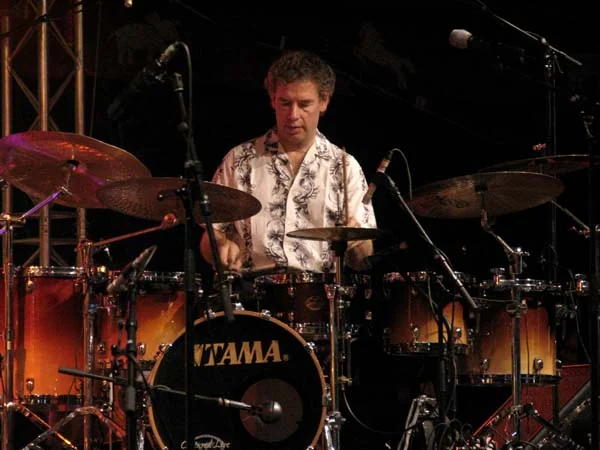
Image from Wikipedia
Image from Wikipedia
Bill Bruford – The Master of Complex Grooves Between Progressive Rock and Jazz
A Drummer Who Redefined Rock
Bill Bruford is one of the defining drummers in British music history. His name stands for precision, polyrhythmic tension, and a distinctive sense of form, dynamics, and timbre. Early on, he combined the energy of Progressive Rock with the discipline of jazz, creating a style that remains a reference for sophisticated drumming to this day. ([de.wikipedia.org](https://de.wikipedia.org/wiki/Bill_Bruford))
Born on May 17, 1949, in Sevenoaks, Kent, Bruford developed a career that took him from the great rock stages of the 1970s to jazz fusion and independent band work. In 2016, Rolling Stone ranked him as the 16th greatest drummer of all time, underscoring his status as a musician with a lasting impact. ([de.wikipedia.org](https://de.wikipedia.org/wiki/Bill_Bruford?utm_source=openai))
Early Years and Musical Influence
Bruford's career began at a time when British rock was reinventing its grammar. He achieved breakthrough success with Yes, a band that brought Progressive Rock to the big stage, combining complex compositions with a high level of technical prowess. His playing was already noted for its metallic snare sound, clear cymbal work, and almost architectural control over odd time signatures. ([allmusic.com](https://www.allmusic.com/artist/bill-bruford-mn0000074776))
The early experiences with Yes laid the foundation for a music career based not on repetition but on evolution. Bruford never regarded drums merely as an accompanying instrument, but rather as a compositional force within arrangements. This attitude quickly made him a sought-after musician in the scene. ([allmusic.com](https://www.allmusic.com/artist/bill-bruford-mn0000074776))
Yes, Genesis, and the Progressive Peak of the 1970s
Bruford initially solidified his name with Yes before briefly playing with Genesis. These turns mark not merely band memberships but central chapters in the history of Progressive Rock, where virtuosity and song architecture drew closer together. Bruford belonged to a generation of musicians who defined the genre from within. ([allmusic.com](https://www.allmusic.com/artist/bill-bruford-mn0000074776))
His subsequent work with King Crimson was particularly formative. There, his rhythmic precision intersected with Robert Fripp's experimental compositional world, and the blend of hard rock, heavy metal, jazz, and avant-garde became a hallmark of the band. The rhythm section of Bruford and Wetton was regarded as exceptionally precise yet improvisationally alert. ([de.wikipedia.org](https://de.wikipedia.org/wiki/Bill_Bruford))
King Crimson and the Art of Control
Between 1972 and 1974, Bruford contributed to three King Crimson albums before the band dissolved after Red. This period remains a milestone for Progressive Rock, as it combined formal strictness with eruptive energy. Bruford's drumming played a crucial role in rendering the music heavy yet fluid, and intellectually charged. ([de.wikipedia.org](https://de.wikipedia.org/wiki/Bill_Bruford))
He later returned to King Crimson multiple times and remained associated with Robert Fripp's changing formations for many years. AllMusic describes his overall development as a career of "inimitable" quality, characterized by complex time signatures, sharp snare sound, and a distinctive sense of form. This continuity made Bruford one of the most stable constants in an otherwise highly mutable band history. ([allmusic.com](https://www.allmusic.com/artist/bill-bruford-mn0000074776))
The Solo Path and the Birth of Bruford
With his solo project Bruford, the drummer forged his own direction, creating a distinctive signature from jazz fusion, rock, and improvisational freedom. The debut album Feels Good to Me was released in 1978, followed by One of a Kind, The Bruford Tapes, and Gradually Going Tornado. These releases showcase a musician who sought not star status but sonic experimentation. ([allmusic.com](https://www.allmusic.com/artist/bill-bruford-mn0000074776))
The lineup with Allan Holdsworth, Jeff Berlin, and Dave Stewart produced a high musical density. Virtuoso solos, harmonic subtleties, and a flexible interplay of rock energy and jazz language defined the sound. In these works, it becomes clear how Bruford viewed drumming as a melodic and structural force. ([allmusic.com](https://www.allmusic.com/artist/bill-bruford-mn0000074776))
Earthworks and Jazz Fusion as a Logical Progression
In the 1980s, Bruford shifted his focus more towards jazz and fusion. With Bill Bruford’s Earthworks, he established an ensemble that combined acoustic and electronic elements into a modern, open band sound. According to AllMusic, he often employed Simmons drums to create an intentionally unconventional sound with brass and bass. ([allmusic.com](https://www.allmusic.com/artist/bill-bruford-mn0000074776))
This phase marks an artistic development rarely pursued so consistently in rock history. Bruford did not shy away from the big performance but rather from the repetition of his own successes. Instead, he sought new forms of collaboration, improvisation, and a language that reconciled jazz intelligence with rock power. ([allmusic.com](https://www.allmusic.com/artist/bill-bruford-mn0000074776))
Style, Technique, and Musical Signature
Bruford's style is based on polyrhythmic precision, polymetric shifts, and extraordinary sonic economy. His playing is never ornamental but functional and highly virtuosic at the same time. The combination of clear articulation, sharp snare character, and controlled dynamics made him a role model for generations of drummers. ([de.wikipedia.org](https://de.wikipedia.org/wiki/Bill_Bruford?utm_source=openai))
In the 1980s, he further influenced drumming through the use of electronic drums and a melodic drumming approach. This shifted the role of drums within the band: away from purely being a timekeeper and towards a compositional co-creator. This development bolstered his reputation as an innovator between rock, fusion, and jazz. ([de.wikipedia.org](https://de.wikipedia.org/wiki/Bill_Bruford?utm_source=openai))
Discography, Reception, and Cultural Influence
Bill Bruford's discography includes essential works with Yes, King Crimson, and Genesis as well as his solo albums and Earthworks releases. AllMusic highlights that his work between 1978 and 1980, with Feels Good to Me, One of a Kind, The Bruford Tapes, and Gradually Going Tornado, formed a dense, stylistically open series. These recordings are regarded as key documents of jazz fusion and sophisticated instrumental rock. ([allmusic.com](https://www.allmusic.com/artist/bill-bruford-mn0000074776))
Later reception remains remarkable: in 1990, readers of Modern Drummer inducted him into the Hall of Fame, and in 2017, he was inducted into the Rock and Roll Hall of Fame as a founding member of Yes. Additionally, the 2022 box set Making A Song and Dance: A Complete-Career Collection collects 70 tracks across six CDs, documenting his entire journey. Bruford's work is thus preserved historically while being actively curated anew. ([billbruford.com](https://billbruford.com/about/))
Current Projects and Later Career
Even in the later stages of his career, Bruford remained present. His official website points to new and recent content in 2026, including a current video about the Bruford recording Gradually Going Tornado as well as podcast appearances showing his role as a reflective musician and commentator on his own career. This confirms that his archive functions not as a museum resting place, but as a living musical memory. ([billbruford.com](https://billbruford.com/))
At the same time, Bruford is once again live with the Pete Roth Trio, a jazz formation that will see him on stages in Europe in 2026. The trio's official site describes the sound as an intimate, improvised, and interactive near-jazz experience, and tour dates confirm performances with Bruford on drums. For a musician long considered retired, this is a late but highly interesting return to the stage. ([peterothtrio.com](https://peterothtrio.com/?utm_source=openai))
Conclusion: Why Bill Bruford Continues to Fascinate
Bill Bruford captivates because he never saw virtuosity as an end in itself. His music career combines progression, jazz thinking, sonic curiosity, and a rare authority at the instrument. Those who listen to his recordings experience not just technique at the highest level but an attitude towards music: attentive, open, uncompromising. ([allmusic.com](https://www.allmusic.com/artist/bill-bruford-mn0000074776))
Especially live, this greatness unfolds most clearly. Bruford's stage presence thrives on intelligence, timing, and the ability to generate tension from rhythmic complexity. Experiencing him in an intimate jazz or fusion setting reveals a musician who continues to write the history of drumming with every movement. ([peterothtrio.com](https://peterothtrio.com/?utm_source=openai))
Official Channels of Bill Bruford:
- Instagram: No official profile found
- Facebook: https://www.facebook.com/billbruford/
- YouTube: https://www.youtube.com/channel/UCGCjL570rm8Gs8j2d5yenZw
- Spotify: No official profile found
- TikTok: No official profile found
Sources:
- Bill Bruford – Official Website - Music, Archive & News
- Bill Bruford – About
- Bill Bruford – Timeline
- AllMusic – Bill Bruford Biography, Discography, Albums & Expert Reviews
- Wikipedia: Bill Bruford
- Bill Bruford – Official Artist Channel
- Facebook – Bill Bruford
- Pete Roth Trio – Official Website
- Pete Roth Trio – Tour Dates & Tickets
- YouTube – Welcome To The Official Bill Bruford YouTube Channel