
Dirk Brockmann
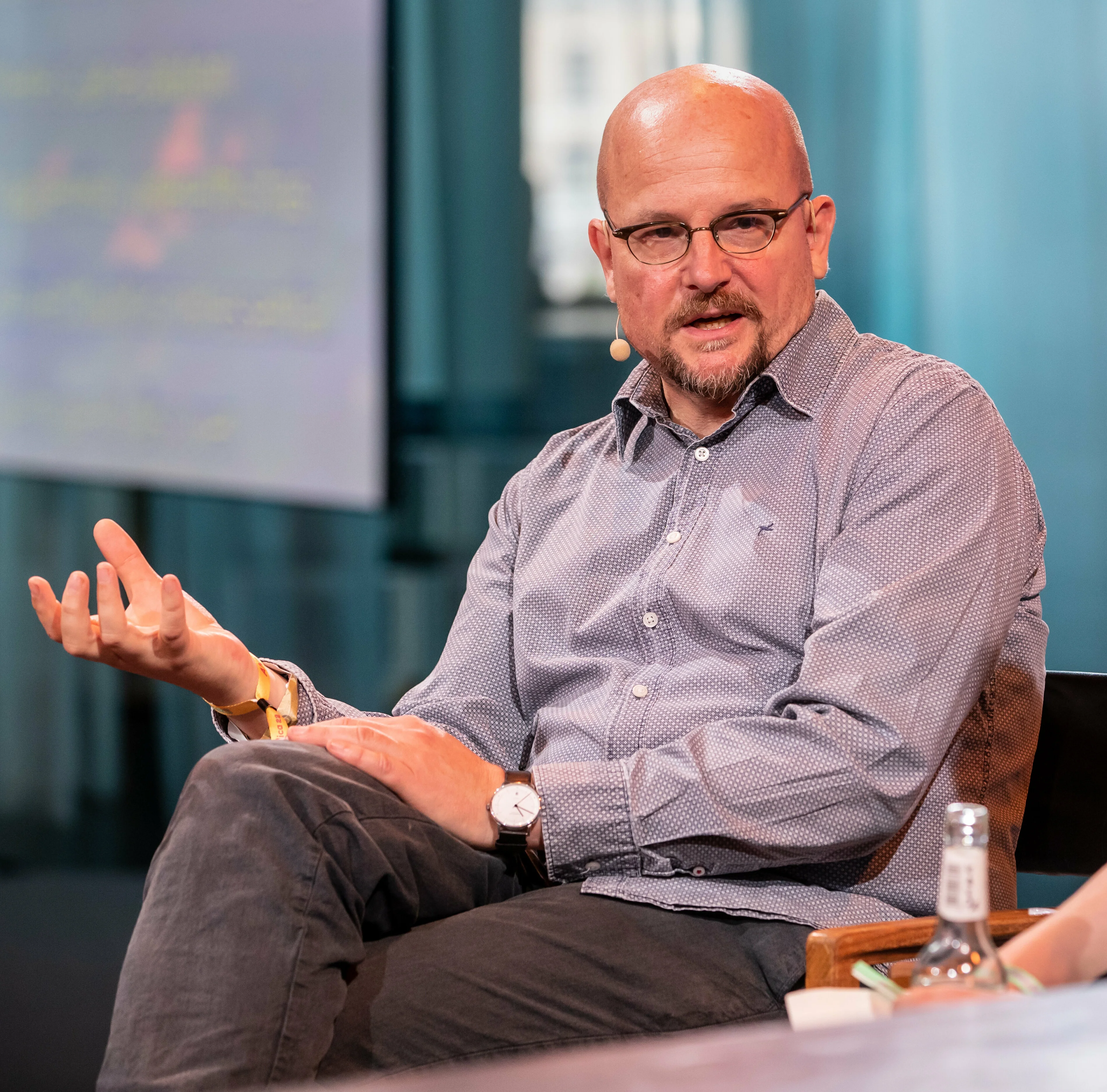
Image from Wikipedia
Image from Wikipedia
Dirk Brockmann – Researcher of Complex Systems, Modeler of Global Dynamics, and Influential Voice in Epidemiology
A Scientist Making the Movements of a Connected World Readable
Dirk Brockmann, born on September 2, 1969, in Braunschweig, is one of the defining German physicists at the intersection of complex systems, networks, and epidemiological modeling. The present Wikipedia text describes him as a professor in the Faculty of Biology at the Technical University of Dresden, a former scientist at the Robert Koch Institute, and director of the Center Synergy of Systems (SynoSys). His work focuses on human mobility, anomalous diffusion, digital epidemiology, and the mathematical description of global spreading processes. ([de.wikipedia.org](https://de.wikipedia.org/wiki/Dirk_Brockmann))
Biographical Foundations and Scientific Influence
Brockmann's career is closely tied to physics as a school of thought, but it extends far beyond classical boundaries. According to Wikipedia, his path led him back to Germany in 2013, where he took a professorship for epidemiological modeling of infectious diseases at Humboldt University of Berlin, before moving to the Technical University of Dresden in 2023. There, he became the founding director of the Center Synergy of Systems, which explores biological and social phenomena using visualizations, data analysis, and mathematical models. ([de.wikipedia.org](https://de.wikipedia.org/wiki/Dirk_Brockmann))
This development illustrates a career consistently focused on interdisciplinarity. Brockmann's research combines physical modeling, network theory, and applied health research into an approach that not only describes complex relationships but also makes them practically usable. This is exactly where his scientific authority lies: He translates abstract systems into comprehensible models without flattening their complexity. ([de.wikipedia.org](https://de.wikipedia.org/wiki/Dirk_Brockmann))
Career Path: From Basic Research to Societally Relevant Modeling
Between 2013 and 2023, Brockmann led the Project Group P 4 at the Robert Koch Institute for the epidemiological modeling of infectious diseases. There, he and his team developed mathematical models, numerical methods, and computer simulations to better understand spreading phenomena of infectious diseases. The Wikipedia biography highlights that this area was part of a collaboration between the RKI and Humboldt University. ([de.wikipedia.org](https://de.wikipedia.org/wiki/Dirk_Brockmann))
His role during the COVID-19 pandemic was especially significant. Brockmann initiated and led the Corona Data Donation project, which according to Wikipedia is described as the largest data donation project worldwide, as well as the Covid-19 Mobility Project, which evaluated mobility in Germany in real-time. These projects shifted the public perception of science: research was no longer seen as abstract analysis but as an immediate tool for societal orientation. ([de.wikipedia.org](https://de.wikipedia.org/wiki/Dirk_Brockmann))
Research Style: Complex Systems, Networks, and Mobility
At the center of Brockmann's scientific signature are complex networks and the dynamics of human movement. Wikipedia lists his topics among others as Computational Neuroscience, anomalous diffusion, human mobility, the spread and dynamics of infectious diseases, digital epidemiology, and complex networks. This illustrates research that does not remain confined to single disciplines but reads phenomena as interlinked processes. ([de.wikipedia.org](https://de.wikipedia.org/wiki/Dirk_Brockmann))
A milestone was a study from 2006 in which Brockmann and colleagues investigated the geographic distribution of millions of dollar bills documented through Where’s George? According to Wikipedia, this work led to universal scaling laws of human mobility, as well as insights into predicting the 2009 flu pandemic in the USA and effective geographical boundaries. His later work on "effective distance" made global spreading processes mathematically clearer and helped estimate import risks during the Ebola epidemic in 2014. ([de.wikipedia.org](https://de.wikipedia.org/wiki/Dirk_Brockmann))
Publications, Communication, and Societal Impact
In 2021, Brockmann published the book Im Wald vor lauter Bäumen, which deals with the complex behavior of animals and humans. Since 2017, he has also been publishing “Complexity Explorables,” interactive illustrations of complex systems. This combination of book, visualization, and modeling work emphasizes his ability not only to research scientific content but also to make it didactically and publicly accessible. ([de.wikipedia.org](https://de.wikipedia.org/wiki/Dirk_Brockmann))
The Technical University of Dresden also places him in this context: In a TUD program, he is mentioned as the director of the Center Synergy of Systems and listed as a panel participant in science communication. This fits a researcher whose work does not remain confined to academic journals but extends into public debates about epidemics, mobility, and societal resilience. ([tu-dresden.de](https://tu-dresden.de/forschung-transfer/ressourcen/dateien/wissenschaftskommunikation/Programm-Tag-fuer-WissKomm_150525.pdf?lang=en&utm_source=openai))
Current Projects and Awards
Recent highlights include the founding of SynoSys at TU Dresden in October 2023. According to Wikipedia, this center promotes a trans- and interdisciplinary approach to explore biological and social systems using visualizations, data analysis, and mathematical models. In 2024, Brockmann was also appointed to the Expert Council for Health and Resilience, and in 2025, his book Survival of the Nettest received the award for Knowledge Book of the Year. ([de.wikipedia.org](https://de.wikipedia.org/wiki/Dirk_Brockmann))
These awards demonstrate that his work has an impact far beyond basic research. Brockmann represents a science that provides orientation because it makes uncertainties, patterns, and feedbacks visible in complex systems. This type of research is particularly relevant in times of crisis. ([de.wikipedia.org](https://de.wikipedia.org/wiki/Dirk_Brockmann))
Discussion of Relevance: Why Brockmann's Work is So Important
Brockmann's scientific significance lies in the connection between theoretical elegance and practical applicability. The systems he examines are global, dynamic, and often hard to predict; this is precisely why his modeling is so valuable. His research on epidemics, mobility, and networks influences health research, risk assessment, and the public communication of science. ([de.wikipedia.org](https://de.wikipedia.org/wiki/Dirk_Brockmann))
His ability to shape structured insights from seemingly unwieldy data streams is particularly strong. The works described in Wikipedia on big data, dollar tracking, and effective distance illustrate a researcher who recognizes patterns where others see only randomness. This is what makes him an important figure in modern complexity research. ([de.wikipedia.org](https://de.wikipedia.org/wiki/Dirk_Brockmann))
Social Media and Official Channels
In the course of the search, no conclusively verified official social media profiles of Dirk Brockmann as an artist or public music act could be identified. Only a LinkedIn profile related to the Technical University of Dresden was found; a verifiable official presence on Instagram, Facebook, or YouTube could not be established. Therefore, there is no "Fans' Voices" section. ([de.linkedin.com](https://de.linkedin.com/in/dirk-brockmann-475436a?utm_source=openai))
Conclusion: A Researcher with Extraordinary Influence
Dirk Brockmann is fascinating because he sees complexity not as an obstacle but as a driver of insight. His career combines basic research, applied modeling, pandemic analysis, and science communication into a remarkably coherent picture. Those who want to understand how modern research makes societal processes visible will find in Brockmann one of the most articulate voices in the German-speaking academic community. ([de.wikipedia.org](https://de.wikipedia.org/wiki/Dirk_Brockmann))
Anyone wanting to experience his work live should keep an eye on lectures, panels, and public formats at the Technical University of Dresden and in scientific contexts. It is precisely there that the unique quality of his research unfolds: precise, interdisciplinary, and highly relevant to the present. ([tu-dresden.de](https://tu-dresden.de/forschung-transfer/ressourcen/dateien/wissenschaftskommunikation/Programm-Tag-fuer-WissKomm_150525.pdf?lang=en&utm_source=openai))
Official Channels of Dirk Brockmann:
- Instagram: No official profile found
- Facebook: No official profile found
- YouTube: No official profile found
- Spotify: No official profile found
- TikTok: No official profile found