
Robert Habeck
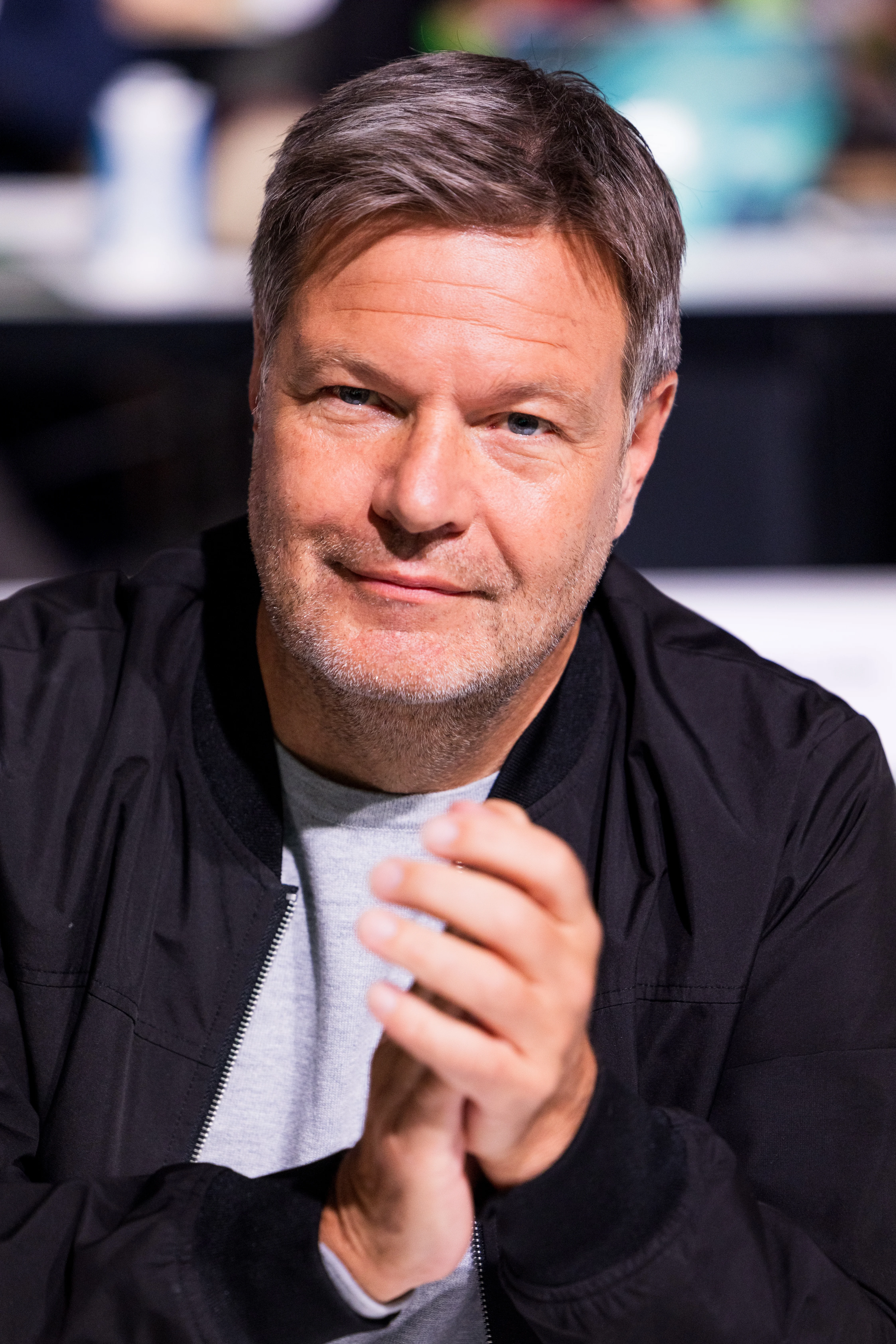
Image from Wikipedia
Image from Wikipedia
Robert Habeck – Language, Attitude, and Political Presence
A German Intellectual Between Literature, Public Life, and Power
Robert Habeck, born on September 2, 1969, in Lübeck, is one of the most influential public figures of his generation. He is known as a writer, Green politician, leader of the parliamentary group and party chairman, as well as the Federal Minister for Economic Affairs and Climate Protection and Vice Chancellor of the Federal Republic of Germany. His career combines political responsibility with linguistic precision, intellectual curiosity, and a remarkably direct form of communication. ([bmwk.de](https://www.bmwk.de/Redaktion/DE/Dossier/Visitenkarten/Habeck/lebenslauf.html?utm_source=openai))
To understand Habeck, one must read him as a political storyteller: someone who translates crises into arguments, arguments into stories, and stories into public impact. His biography is that of a man who found his way into politics through literature, philosophy, and language, developing a unique tone in the process. This combination of reflection, presence, and strategic thinking makes his character exceptional in German politics. ([bmwk.de](https://www.bmwk.de/Redaktion/DE/Dossier/Visitenkarten/Habeck/lebenslauf.html?utm_source=openai))
Biography: From the North to National Public Life
Habeck studied German, philosophy, philology, as well as literary studies and philosophy in Freiburg, Roskilde, and Hamburg; later completing his studies with a Master's degree. Before starting his federal political career, he worked as a writer, including collaborations with his wife Andrea Paluch. This literary background continues to shape his style today: analytical, rich in imagery, and aimed at clarity. ([bmwk.de](https://www.bmwk.de/Redaktion/DE/Dossier/Visitenkarten/Habeck/lebenslauf.html?utm_source=openai))
His political journey began in Schleswig-Holstein. Since 2009, he was a member of the state parliament there, later becoming group chairman, and, from 2012, Deputy Minister President and Minister for the Energy Transition, Agriculture, Environment, and Nature, later also for Digitalization. The years in Kiel shaped Habeck as a government practitioner who understood state politics, structural change, and the energy transition not as buzzwords, but as concrete tasks for design. ([bmwk.de](https://www.bmwk.de/Redaktion/DE/Dossier/Visitenkarten/Habeck/lebenslauf.html?utm_source=openai))
On the federal level, Habeck rose from 2018 to become one of the most visible faces of the Greens, initially as Federal Chairman alongside Annalena Baerbock. From 2021 to 2025, he was a member of the German Bundestag, also serving as Federal Minister for Economic Affairs and Climate Protection and Deputy Federal Chancellor. This shift definitively moved his profile from state politics to the forefront of national power. ([bmwk.de](https://www.bmwk.de/Redaktion/DE/Dossier/Visitenkarten/Habeck/lebenslauf.html?utm_source=openai))
Career: Party Leadership, Crisis Management, and Government Practice
Habeck’s career represents a rare combination of party work, government experience, and strategic communication. Together with Annalena Baerbock, he led Alliance 90/The Greens through a phase of increasing federal political relevance and was part of the lead duo for the Bundestag election in 2021. In 2025, he himself ran as his party's chancellor candidate. This development shows a politician who has grown from the role of moderator to that of a central decision-maker. ([bmwk.de](https://www.bmwk.de/Redaktion/DE/Dossier/Visitenkarten/Habeck/lebenslauf.html?utm_source=openai))
Habeck became particularly visible during times of crisis. In official speeches and government publications, he appeared as a minister who interconnected economic, energy policy, and geopolitical challenges. His communication was often described in the press as explanatory, accessible, and unusually precise, distinguishing him from many other top politicians. ([bundesregierung.de](https://www.bundesregierung.de/breg-de/service/newsletter-und-abos/bulletin/bmwk-energiewirtschaftsgesetz-2271080?utm_source=openai))
His working style is closely connected to North German practicality. The official records of his political career indicate that he always understood regional responsibility as a substantive task: nature conservation, energy transition, agriculture, rural areas, digitalization, and social cohesion formed recurring focal points. This thematic breadth explains why Habeck is perceived far beyond the classic party profile. ([robert-habeck.de](https://www.robert-habeck.de/wp-content/uploads/20201005_RH_Bewerbung_Listenplatz.pdf?utm_source=openai))
Literary Work and Public Profile
Robert Habeck is not only a politician but also a writer. This dual role shapes his public image: he argues not only with numbers and programs but with concepts, interpretations, and moral considerations. In his political language, one can sense the influence of literature and philosophy, stemming from contemplation on texts, responsibility, and societal order. ([bmwk.de](https://www.bmwk.de/Redaktion/DE/Dossier/Visitenkarten/Habeck/lebenslauf.html?utm_source=openai))
His blog and public communication showcase an author who analytically comments on political debates and sharpens conflicts linguistically. Early on, he positioned himself on social issues with a clear tone and a language focused more on argumentation than slogans. This grants him authority, as he not only engages in politics but also linguistically shapes political significance. ([robert-habeck.de](https://www.robert-habeck.de/blog/religion-zu-folklore/?utm_source=openai))
Style and Impact: Clarity as a Political Signature
In media perception, Habeck is regarded as a communicative counterpoint to sober, often reserved governmental rhetoric. Several press articles describe his language as comprehensible, vivid, and effective in public discourse. Especially during crises, he is credited with transforming complex government policy into an understandable narrative. ([gfds.de](https://gfds.de/wie-spitzenpolitiker-in-der-krise-krise-kommunizieren/))
This effect is not coincidental but part of his political staging. Habeck works with tone, structure, and rhythm, not just with content. This creates a kind of rhetorical stage presence reminiscent of music journalism: he uses pauses, condenses themes, and builds tension arcs. In politics, this is rare; however, in Habeck's case, it is central to his charisma. ([gfds.de](https://gfds.de/wie-spitzenpolitiker-in-der-krise-krise-kommunizieren/))
Current Projects and Political Presence
Among the more recent officially documented projects are his roles in the federal government, his appearances in the Bundestag, and his work on budget, economic, and energy issues. A letter from July 2024 shows him as a leading negotiator in the government coalition; he emphasizes economic stabilization, the transition to climate-neutral renewal, and the geopolitical consequences of Russia's attack on Ukraine. Thus, Habeck remains a central figure in contemporary German politics. ([robert-habeck.de](https://www.robert-habeck.de/storage/2024/07/Brief_Robert_Habeck_zur_Einigung_Haushalt.pdf?utm_source=openai))
Even after his time as minister, his name remains associated with green politics, economic transformation, and public debate. Official sources depict an actor who continues to view himself as a political shaper and carries his themes into discourse beyond election campaigns. This is crucial for public perception: Habeck does not disappear from the conversation; instead, he continuously shapes it. ([bmwk.de](https://www.bmwk.de/Redaktion/DE/Dossier/Visitenkarten/Habeck/lebenslauf.html?utm_source=openai))
Discography, Publications, and Cultural Impact
In the classical sense, Robert Habeck does not have a musical discography; his publication history lies in the literary and political realm. Search results show books, essays, blog posts, speeches, and discussion formats, but no albums, singles, or chart placements. For an artist page, this is important as Habeck is culturally significant not as a musician, but as an author and political speaker. ([bmwk.de](https://www.bmwk.de/Redaktion/DE/Dossier/Visitenkarten/Habeck/lebenslauf.html?utm_source=openai))
His cultural impact thus derives from language, attitude, and public effectiveness. Habeck represents a form of political intelligence that employs literary means, thus reaching a broader audience. He embodies the rare figure of a politician who functions as a storyteller, interpreter, and mediator, extending well beyond purely party politics. ([t-online.de](https://www.t-online.de/themen/robert-habeck/?utm_source=openai))
Conclusion: Why Robert Habeck Remains Fascinating
Robert Habeck remains fascinating because he does not merely manage politics but shapes it linguistically and intellectually. His career connects literature, government experience, crisis management, and an unusually strong public presence. Those who follow his development see an actor who has not only accompanied German contemporary history but has also helped to shape it. ([bmwk.de](https://www.bmwk.de/Redaktion/DE/Dossier/Visitenkarten/Habeck/lebenslauf.html?utm_source=openai))
This very mix of reflection, responsibility, and stage presence is what makes him an extraordinary figure. He is not a classic pop star, not a musician, nor an artist in the conventional sense, but a political author with a strong aura. Anyone who encounters him live – in speech, debate, or interview – experiences a public figure who masters language as an instrument of leadership. ([gfds.de](https://gfds.de/wie-spitzenpolitiker-in-der-krise-krise-kommunizieren/))
Official Channels of Robert Habeck:
- Instagram: https://www.instagram.com/robert.habeck/
- Facebook: no official profile found
- YouTube: https://www.youtube.com/channel/UCOUfV2mSQuD4JzNFE6zsjmQ
- Spotify: no official profile found
- TikTok: no official profile found
Sources:
- BMWK - Dr. Robert Habeck Curriculum Vitae
- Federal Government - Speech by the Federal Minister for Economic Affairs and Climate Protection, Dr. Robert Habeck, April 12, 2024
- Federal Government - From Government Circles, Issue 48, Transcript
- Robert Habeck - Official Website
- Robert Habeck - Blog: Religion to Folklore
- GfdS - How Top Politicians Communicate in Crisis
- Robert Habeck - Application for Direct Mandate (PDF)
- Robert Habeck - Application for List Position 2 (PDF)
- Robert Habeck - Application for State List Position 2 (PDF)
- Robert Habeck - Letter on the Agreement on the Budget 2025 (PDF)
- Wikipedia: Image and Text Source